Cheapest Prop Firm Account Size: What It Really Costs
Material update: Site-wide prohibited-phrase cleanup applied on 2026-08-23; editorial review status was not changed.

What 'minimum account size' means at a prop firm
At a prop firm, the minimum account size is the smallest simulated balance the firm sells an evaluation for. It is not a deposit: you pay a one-off fee, trade the simulated account under fixed loss limits, and only the fee is your money at risk. The cheapest entry is therefore the lowest fee for the smallest account, but the cheapest route to a payout depends on more than that sticker price.
Every price and rule below was checked on 17 October 2026 on the firms' own pages, linked in the text. Prop firms change products and run promotions often, so treat the figures as a dated snapshot and confirm the basket total before you pay.
Three numbers matter together: the fee, the loss room in dollars that the smallest account gives you, and whether and when the fee comes back.
Smallest accounts and lowest prices we checked
| Programme | Smallest size | Lowest price shown | Loss limits | Fee refund |
|---|---|---|---|---|
| FundedNext Stellar Lite | $5,000 | $32.99 (a lower promotional figure was also shown) | 4% daily, 8% maximum | With the 3rd reward |
| FundedNext Stellar 2-Step | $6,000 | $59.99 list price (promotional price also shown) | 5% daily, 10% static maximum | With the 1st reward |
| FTMO Challenge 1-Step | $10,000 | From EUR 79 | 3% daily, 10% end-of-day trailing | Not refundable |
| FTMO Challenge 2-Step | $10,000 | From EUR 89 | 5% daily, 10% static | With the first reward |
| FTMO Instant Account | $5,000 | From EUR 169 | 3% daily, 10% intraday trailing | Not refundable |
| FXIFY | $1,000 in the checkout size list (varies by programme) | No base price before options are chosen | Two Phase: 4% daily, 10% trailing | 1, 2 and 3 Phase: with the first payout, on request |
Sources: FundedNext Stellar Lite, FundedNext Stellar 2-Step, FTMO comparison table, FTMO account sizes, FTMO refund FAQ and FXIFY assessment rules. FXIFY's checkout showed add-ons at $50 each but no base fee until a programme and size were selected; its official 2-Phase Pro launch article (29 April 2026) lists $129 for a $10,000 account.
FTMO publishes "from" prices in euros, while FundedNext and FXIFY price in dollars. Convert at the rate your card issuer will apply before ranking them.
What a small account leaves you in loss room
A cheap fee buys a small dollar budget for losses. Applying each firm's percentages to the smallest sizes:
- FundedNext Stellar Lite, $5,000: daily 4% = $200, maximum 8% = $400.
- FundedNext Stellar 2-Step, $6,000: daily 5% = $300, maximum 10% = $600.
- FTMO 1-Step, $10,000: daily 3% = $300, maximum 10% = $1,000.
- FTMO 2-Step, $10,000: daily 5% = $500, maximum 10% = $1,000.
- FTMO Instant, $5,000: daily 3% = $150, maximum 10% = $500.
One useful ratio is fee divided by maximum loss room. For the two FundedNext entries: $32.99 / $400 = 8.2% and $59.99 / $600 = 10.0%. The lower ratio means more room per fee dollar, but it says nothing about whether your strategy fits that room, which is the next question.
Costs beyond the challenge fee
- Add-ons. FundedNext charges a non-refundable usage fee for its EA add-on, available only on accounts below $50,000 (FundedNext EA policy). FXIFY listed checkout add-ons at $50 each.
- Trading costs inside the account. Commissions and swaps reduce equity; FTMO defines the equity its limits watch as balance plus open profit or loss, plus or minus swaps, minus commissions (FTMO trading objectives).
- Repeat purchases. A failed attempt never produces a payout, so its fee does not come back.
- Your own tools. Data, a VPS or software, if you automate.
- Currency conversion on the fee and on any payout.
Our commission and fee ledger shows how to total these without counting anything twice.
Worked example: sizing trades on a $5,000 account
This example is illustrative. Take the Stellar Lite figures above: $200 of daily loss room on $5,000. You decide to risk 0.5% per trade, which is $25.
- On EURUSD a standard lot moves about $10 per pip. With a 20-pip stop: $25 / (20 x $10) = 0.125 lots, rounded down to 0.12 lots.
- Actual risk: 0.12 x 20 x $10 = $24 per trade.
- Full losses before the daily limit: $200 / $24 = 8.3, so 8.
Now suppose your method needs a 50-pip stop and you never trade below 0.10 lots. Risk per trade becomes 0.10 x 50 x $10 = $50, so only $200 / $50 = 4 losing trades fit in a day. On a $10,000 FTMO 2-Step with $500 of daily room, the same trade fits 10 times. In that case the cheapest account is the wrong account, and paying more for a larger size can cost less overall.
Refunds, promotions and repeat attempts
Refund timing changes the real cost. FTMO returns the 2-Step fee with the first reward withdrawal, but not the 1-Step or Instant fee. FundedNext refunds the Stellar 2-Step price with the first reward and the Stellar Lite price with the third, according to its Stellar Lite help article. FXIFY reimburses 1, 2 and 3 Phase fees with the first payout, on request.
Promotions come and go, and the price on a reset may differ from the first purchase. FundedNext states that the purchase or reset price paid is what it refunds, so a discount also lowers the refund. Illustrative budget: three attempts on Stellar Lite at $32.99 cost 3 x $32.99 = $98.97, and only the fee of the account that eventually pays a third reward comes back. Decide in advance how many attempts you will fund and what you will change after each one.
A cost checklist before you pay
- Write down the smallest size, the price in your currency and the refund condition.
- Convert the daily and maximum loss percentages into dollars for that size.
- Check that your usual stop and minimum lot fit at least five or six losing trades inside the daily room.
- Add add-ons, commissions, swaps and tool costs.
- Confirm that your style is allowed: news, weekends, EAs, copiers.
- Set an attempt budget and stop when it is used.
For rule details by firm, see FTMO Challenge rules and choosing a FundedNext challenge.
Where JPTC software fits
If you automate, the JPTC EA Hub offers MT4/MT5 software and setfiles that you download and run yourself, on your own terminal or VPS. No prop firm has approved it, and no setting guarantees rule compliance, so check each firm's EA policy first; at FundedNext, for example, EAs are limited to accounts under $50,000. Size the inputs against the dollar loss room you calculated above.
The JPTC Algo is a separate, hosted service: JPTradingCapital runs it on its own infrastructure, connected to your own MT4/MT5 broker account, with nothing to install and no VPS. It is not offered for prop-firm evaluations. Company-published monthly figures from the broker statement are on the results page.
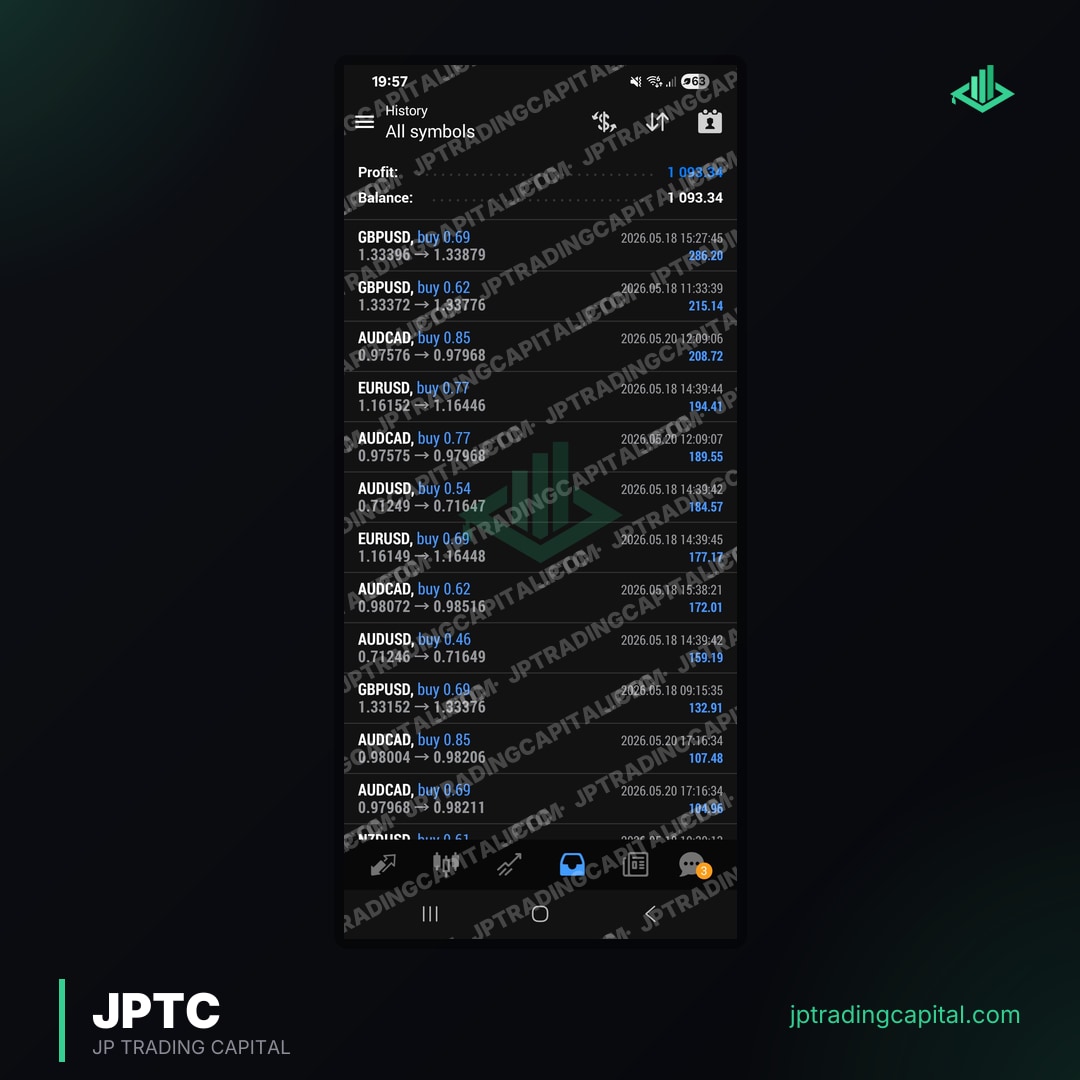
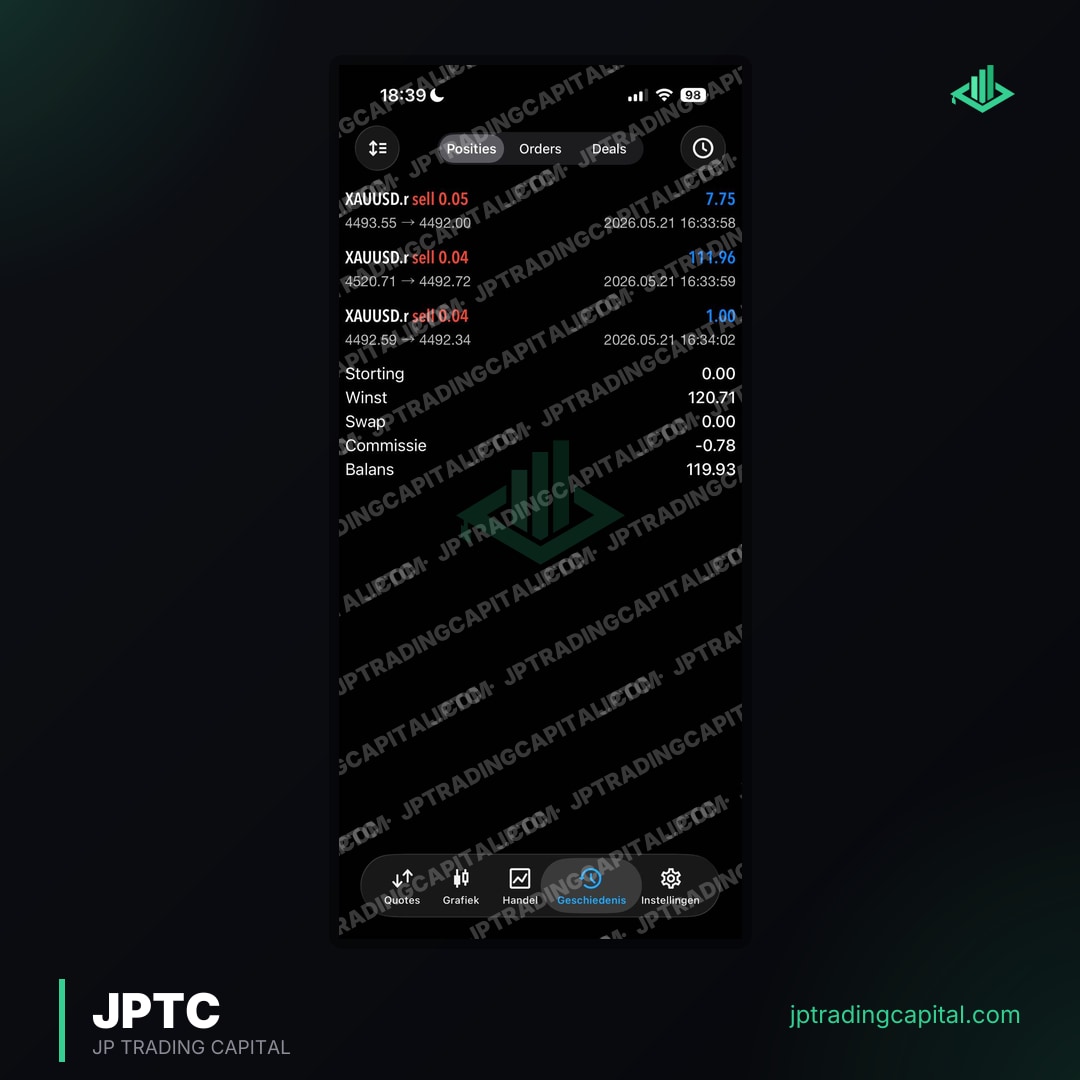
Company-published account screenshots
Individual examples, not typical results or challenge outcomes. See /results for the monthly figures.




What is the cheapest prop firm account we found?
Is a $5,000 account a deposit I can lose?
Is the cheapest account always the cheapest way to get funded?
Which challenge fees are refundable?
Can I run an EA on the smallest accounts?
Related articles
Forex & Gold Signals, No Monthly Fee
Entry, stop loss and targets on every trade we take. It costs you nothing: open an account through one of our partner brokers and they cover it for you. You place every trade on your own account.
Join the signals channel