FundedNext Challenge: loss budgets, sizing and software rules

There is no evidenced shortcut or typical number of days to pass FundedNext in this guide. Minimum trading days are eligibility conditions, not a forecast. Useful preparation means identifying the purchased program, calculating the actual loss room and checking whether your execution method is permitted. Rules below were checked on 16 October 2026.
Start with the exact Challenge product
The Stellar 2-Step Challenge page lists targets of 8% in Phase 1 and 5% in Phase 2, a 5% Daily Loss Limit and 10% Maximum Loss Limit, with no deadline to reach the targets. The standard minimum is five separate trading days per phase. The same page offers a No Minimum Trading Days add-on for eligible smaller account sizes; check whether it was actually purchased. Stellar 1-Step, Stellar Lite and futures have different conditions. Do not reuse an old Evaluation, Express or Rapid timetable for every account.
Check permission before automating anything
The EA policy permits eligible MT4/MT5 automation only below $50,000 with the required EA add-on and other strategy conditions. At $50,000 and above the account must be traded manually, including SL/TP/lot-management actions that an automated tool would perform. cTrader and Match-Trader do not allow EAs regardless of size. The policy also prohibits bots designed specifically to pass prop-firm challenges and imposes distinct-strategy restrictions. A downloaded preset, backtest or JPTC product page is not permission; a risk calculator that modifies trade parameters can also fall under the EA rules.
Separate the daily calculation from the overall floor
According to the daily-loss calculation guide, the allowance is the initial balance multiplied by the percentage of the enrolled Challenge. Current-day closed results and floating results count, including swaps, commissions and fees. The calculation resets at 00:00 server time, with seasonal server-time changes. Closed profit from yesterday does not remain today’s extra daily cushion. For Stellar 2-Step, the separate overall floor is 90% of the initial balance. Check both constraints and open exposure before another order. An internal stop is a chosen buffer, not the official threshold, and cannot guarantee that gaps or execution failures will stay inside it.
Position sizing: one explicit arithmetic example
This is an illustrative calculation, not a recommended position or permission to automate a $50,000 account. Assume a USD account, EUR/USD with a 100,000-unit standard contract and a pip of 0.0001. One pip is then $10 per standard lot. For a hypothetical $250 planned price loss and a 50-pip stop: lots = 250 ÷ (50 × 10) = 0.5. At 2.5 lots that same move would lose $1,250 before costs, not $250. Check the actual symbol’s contract, currency conversion, minimum volume and volume step; round down if rounding up would exceed the chosen budget.
Costs and exposure change the planned loss
Add estimated commission, spread where not already reflected, and adverse execution to the budget. Do not count the spread twice. For a separate hypothetical cost example, a 0.7-pip spread at $10 per pip plus a $7 round-trip commission costs $14 per standard lot, or $7 at 0.5 lot, before slippage and swaps. Five such round trips cost $35, not merely the $17.50 commission component. Six planned losses of $250 total $1,500 before costs; that is not a universal daily trading allowance or a claim that six losses are affordable on every account. Open positions must be included.
Correlation depends on trade direction
Long EUR/USD and long GBP/USD can share short-USD exposure. Long EUR/USD and short USD/CHF can also reinforce short-USD exposure; a negative correlation between the quoted pairs does not automatically make those trade directions a hedge. Correlations vary by sample, frequency and market regime. More pairs are not automatically diversification, and there is no substantiated universal optimum of two positions or three to six pairs. Review position direction, size and joint loss scenarios, not only a historical correlation coefficient.
Test a decision process, not a promised passing rate
Document entry and exit conditions, planned loss, remaining account room, costs and reasons to stop. ATR describes historical trading ranges; it does not predict the next gap or make an ATR-based stop safe. Use appropriate historical tests, out-of-sample periods and permitted demo testing, with the exact version and settings recorded. A fixed 99% modelling score, trade count, profit factor or Sharpe threshold does not certify a passing rate. The Quick Strike rule separately restricts profit concentrated in positions closed within 30 seconds; at 30% or above, Challenge progression is held until the share falls below the threshold. That is different from automatically terminating the Challenge. News and session filters must follow the selected account’s calendar and restrictions; no universally safer trading session is established here.
Recheck conditions before the next phase
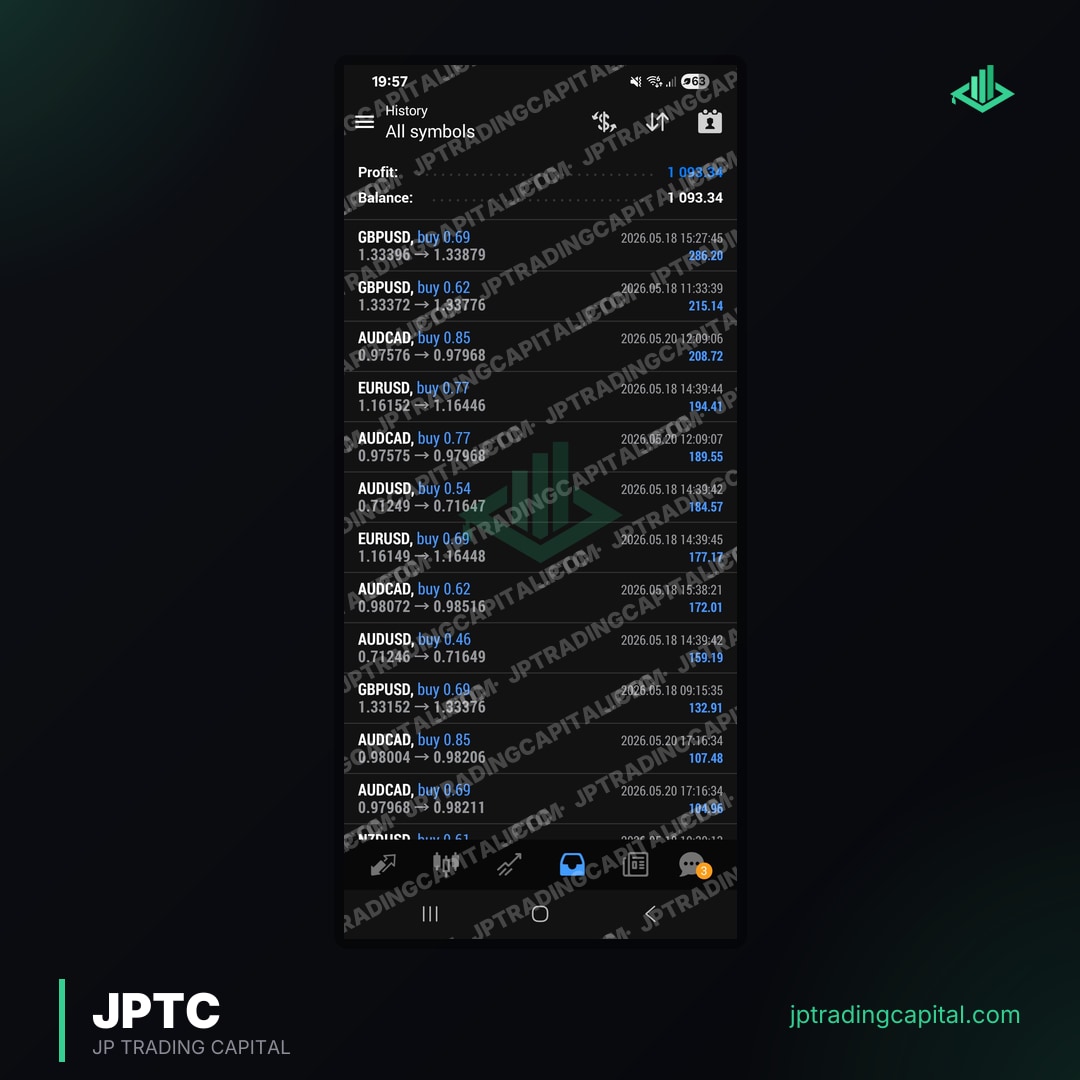
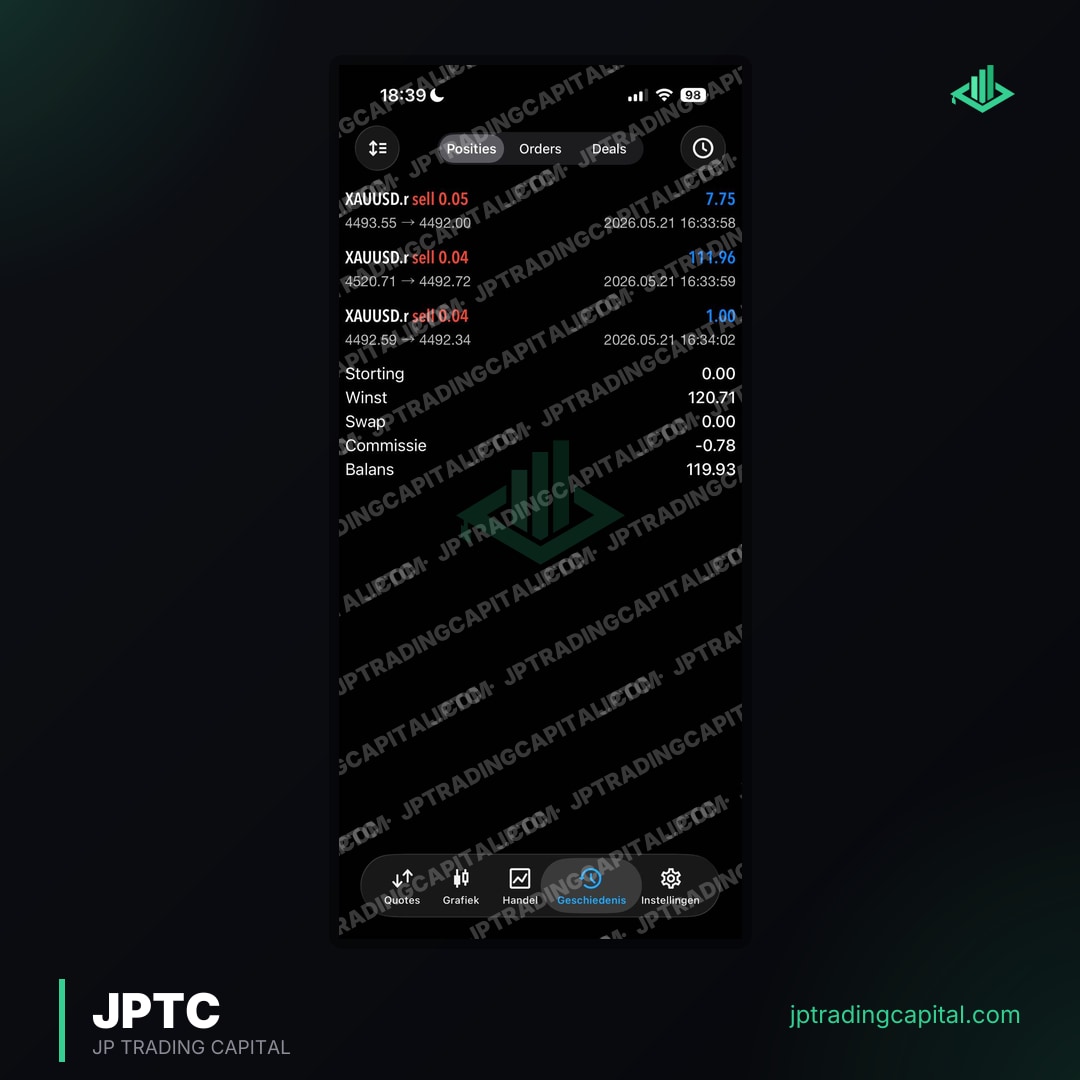
Keep a journal of actual decisions and errors, and recheck the program before advancing. Eligibility, compliance review, KYC and the next account’s agreement remain separate from reaching a profit target. Rules can differ after the Challenge. The EA Hub offers software and setfiles, not approval by FundedNext. JPTC’s separately hosted Algo requires no customer installation or VPS; its own monthly brokerstatement publication is not an independent audit or evidence for a particular EA Hub file. Neither an account record nor a technical guard guarantees a Challenge result or payout.




Questions about FundedNext risk planning
How quickly can I pass a FundedNext Challenge?
The selected model and purchased add-ons determine minimum days, while actual results are uncertain. The standard Stellar 2-Step requires five days per phase and has no target deadline. That does not establish a typical completion time or justify extra trades to fill a calendar.
Can an EA or risk tool make sure I stay compliant?
No. Software permission is product-, size- and platform-specific, and technical failures can still breach limits. FundedNext prohibits automation at $50,000 and above and challenge-passing-specific bots; some parameter-management tools are classified as EAs too.
Is 2.5 lots correct for $250 risk with a 50-pip EUR/USD stop?
Not under a USD 10-per-pip standard-lot assumption. The calculation is 250 / (50 × 10) = 0.5 lot before costs. 2.5 lots would expose $1,250 to that price move before costs. Actual contract specifications and volume rounding must also be checked.
Does a high win rate establish how many trades I need?
No. Average win and loss, costs, dependence between trades and the order of outcomes matter. An expected-value calculation is not a promised path to a target. No universal passing rate, number of trades per day or profit/drawdown qualification ratio is established here.
Pedro Penin, founder of JPTradingCapital.
Related Articles
- FundedNext Prop Firm Explained: Strategies for Passing Evaluations & Maximizing Payouts in 2024 · Read more →
- Trade Copier Explained: The Ultimate Guide for Prop Firm Traders in 2024 · Read more →
- Gold Trading Volatility: How to Trade XAUUSD During Market Events · Read more →
- Best Time to Trade Gold (XAUUSD): Market Hours and Strategy Guide for Prop Firm Success · Read more →
- Futures Trading for Beginners: A Comprehensive Guide to ES, NQ, Gold, and Oil · Read more →
- Algo Trading Drawdown Protection: Automating Risk Management Across Multiple Accounts · Read more →
- Discord Trading Signals vs Automated Algo Trading: The Definitive 2026 Guide for Prop Firm Success · Read more →
- Algo Trading Strategy Backtesting: A Step-by-Step Process for Prop Firm Forex & Futures Traders · Read more →
Review the JPTC EA Hub
EA software with version-specific documentation and account-level risk controls. Review the selected programme’s current automation rules and test the chosen version; software does not guarantee compliance, a pass or a payout.
See the EA Hub