Best EA for FTMO 2026: What to Check Before You Buy One
Material update: 15 October 2026: specifically identified source references, unsupported own-product/result qualifications or account-rule wording corrected. Existing publication status and URL retained. 15 October 2026: Additional own-results verification/audit wording corrected to company-published broker-statement scope.

The best EA for FTMO is one that respects a 10% maximum drawdown limit, stays within daily loss caps, and delivers consistent results over 30+ days without blowing the account or triggering aggressive scaling rules. Unlike retail EAs optimized purely for profit, a FTMO EA must navigate a ruleset designed to enforce risk discipline, and most generic bots fail because they ignore these constraints entirely.
- FTMO max drawdown: 10% account equity, non-negotiable rule
- Daily loss limit: a 5% equity loss below the day's starting balance ends the evaluation
- Minimum trading days: 4 per phase, with no time limit
- EA must preserve capital first, scale only after proven consistency
- Backtested data alone isn't enough; live market stress-testing matters
What Makes a Winning FTMO EA?
Not all EAs are created equal when prop-firm rules are in play. A retail EA that crushes a backtest on 10:1 leverage will blow a FTMO account in weeks because it was never designed to survive a 10% drawdown ceiling or daily loss cutoff.
The FTMO ruleset is public knowledge, but the skill lies in operationalizing it. FTMO's official rules page specifies that on the 2-Step, losing more than 5% of the initial balance in one day breaches the Maximum Daily Loss and ends the challenge, and so does a total loss of 10% of the initial balance, a static limit that is not measured from peak equity. These aren't suggestions, they're hard stops.
A winning best EA for FTMO must:
- Cap position size dynamically, If the EA is down 3% on the day, it shrinks the next trade or stops entirely. This requires pre-built logic, not post-hoc risk management.
- Avoid over-clustering in one direction, Taking 15 long trades on correlated pairs in a single session multiplies drawdown risk. Diversification isn't optional.
- Trade liquid pairs during overlap hours, EURUSD, GBPUSD, and USDJPY at London/NY overlap have tighter spreads and faster fills. An EA that trades exotics at 4 AM gets whipsawed on slippage.
- Bank profits incrementally, not all-or-nothing, Scaling in over 30 days looks better to evaluators than a single 8% spike followed by a drawdown.
- Backtest against real historical stress, Simulate the 2020 COVID crash, the 2023 SVB collapse. If your EA survived those, it can survive most FTMO evaluations.
Top FTMO EAs Reviewed in 2026
1. JPTC EA Hub
The JPTradingCapital EA Hub is purpose-built for prop-firm evaluations across FTMO, FundedNext, and other firms. It ships with pre-backtested strategies configured to respect drawdown and daily loss limits out of the box.
Key strengths:
- Multi-strategy module: Rotate between trend, mean-reversion, and volatility algos depending on market regime
- Built-in position-sizing that scales down after 3% daily loss
- Supports MT4 and MT5 seamlessly
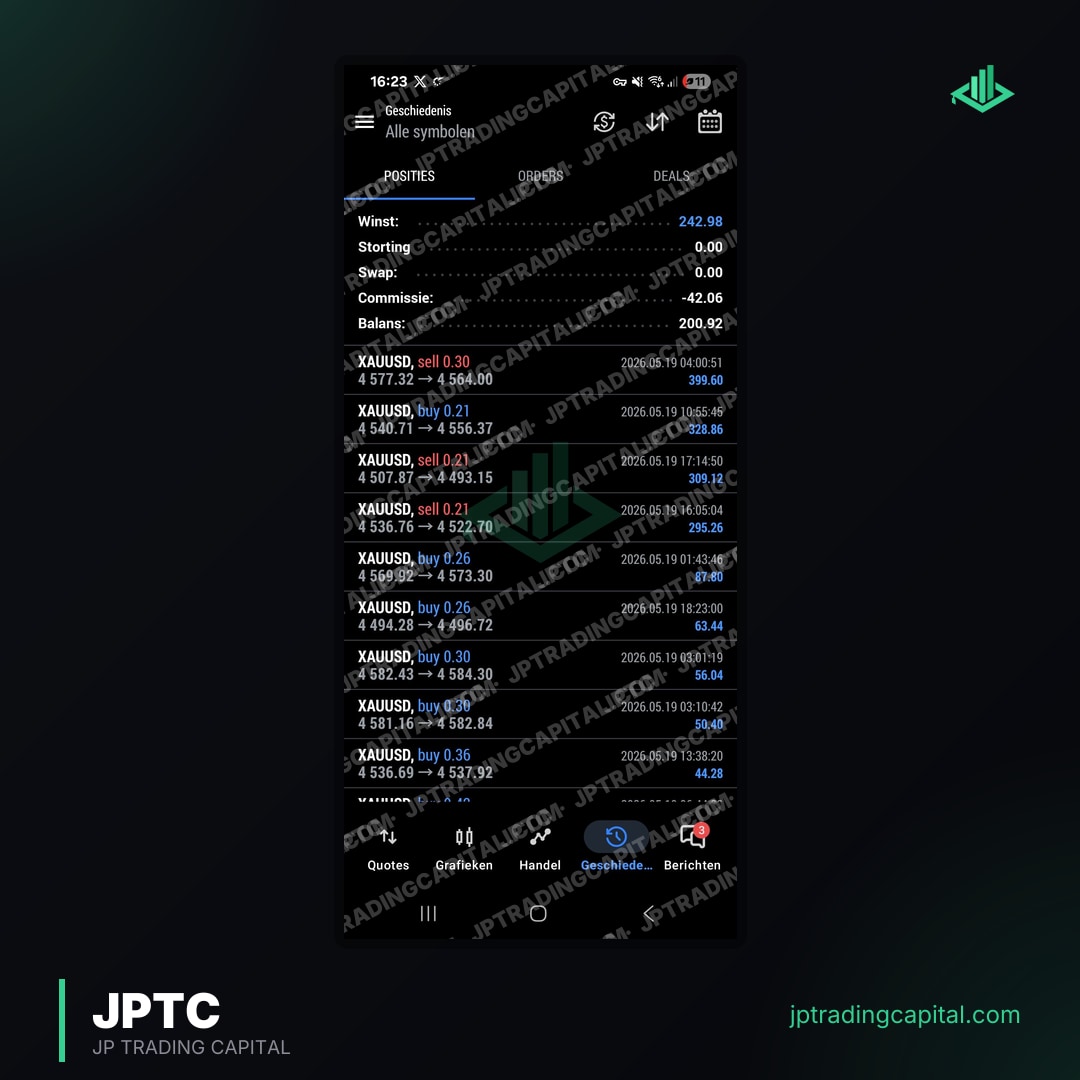
- JPTradingCapital publishes monthly figures from broker statements on its results page. The broker’s own account record is not an independent audit; these figures do not establish future performance or compliance for another strategy.
- Presets you can adjust per phase, since Phase 1 and Phase 2 parameters differ
Pricing is transparent, and it's designed for traders who want a working bot the day they receive it, not a months-long tuning project. Setup is a download for your own MT4 or MT5 terminal on a PC or VPS.
2. Grid-Based EAs for FTMO
Grid EAs enter multiple positions at set intervals as price moves, banking small profits on each tier. Popular choices include Grid Infinity and similar bots marketed on MQL5.
Pros:
- Mechanical discipline, no emotion, trades exact rules
- High win rate on ranging pairs (EURUSD during consolidation phases)
- Clear entry/exit logic that auditors can verify
Cons:
- Catastrophic drawdown risk if price runs 200+ pips against the grid
- Requires careful pair selection (avoid high-volatility assets like GBP/JPY)
- Many grid EAs blow FTMO accounts within 2 to 3 weeks because traders under-size the grid spacing
Grid EAs can work on FTMO, but they demand tighter parameter calibration than most retail users apply.
3. Trend-Following Bots
EAs based on moving average crossovers, MACD, or ADX filters are the safest category for prop firms because they align with market direction and exit early on reversal signals.
Examples include strategies built around the 50/200 MA crossover on higher timeframes (4H, Daily) combined with volatility filters to avoid whipsaws in low-liquidity sessions.
Strengths:
- Lower win rate (40 to 55%) but larger average win vs. loss ratio
- Align with actual market structure, most traders recognize trend-following as sound
- Drawdown curves tend to be smoother, less prone to sudden spikes
Weakness:
- Slow to capture trends during strong directional moves
- Generate false signals in choppy, sideways markets (common in summer/holidays)
How to Choose the Best EA for FTMO: A Practical Checklist





1. Verify Rules Compliance Before Backtesting
Before running any test, confirm the EA has built-in guards:
- Does it cap daily loss at 5% or lower? (Check the code or settings documentation.)
- Does it stop trading after hitting daily loss limit? (Most don't, this is a red flag.)
- Does it account for slippage and commissions in position sizing?
An EA that looks profitable in a perfect backtest but ignores slippage will fail in live markets. FTMO accounts trade with real spreads; make sure your backtest does too.
2. Test on 3 Different Timeframes
A best EA for FTMO should perform consistently across H1, H4, and D1 charts. If it only works on M5 scalping, it's fragile.
- Scalping (M5, M15): High win rate, frequent exits, but vulnerable to slippage
- Swing (H1, H4): Moderate trade frequency, smoother equity curve
- Position (D1+): Few trades per month but larger % gain per trade
Multi-timeframe logic (e.g., enter on H1 signal, confirm on H4 trend) tends to produce better FTMO results.
3. Run Stress Tests on Historical Crashes
Before you deploy on FTMO, stress-test against:
- March 2020 (COVID), Sharp reversal, 10% daily swings normal
- March 2023 (SVB collapse), Banking sector contagion, EURUSD volatility spike
- Sept 2022 (BOE intervention), GBP rallied 10% in a single session; hedge funds blew up
If your EA held up through those, it's robust. If it would have hit the 10% drawdown ceiling, it's not ready for FTMO.
4. Compare Live Track Records, Not Backtests
Backtests are optimistic. They ignore gaps at market open, they assume fills at bid/ask, and they can be curve-fit to almost any dataset. Live results are the only truth.
Before buying an EA, ask:
- Check the original account data, reporting period, drawdowns and test conditions.
- How many FTMO accounts has it passed? (Testimonials help, but they're not audited.)
- What's the maximum drawdown in the live track record, and did it respect FTMO limits?
A year of live trading with a 6 to 8% max drawdown beats a backtest claiming 20% annual return.
Common FTMO EA Mistakes to Avoid
Mistake 1: Over-Optimizing the Backtest
Curve-fitting parameters to historical data (e.g., using a 23-period MA instead of 20, or adding filters that worked in 2022 but break in 2024) is tempting and easy to do in most backtesting software. The EA passes the test but fails in live trading because it was tuned to past data, not future market behavior.
Solution: Use walk-forward analysis. Split your test period into in-sample (optimize here) and out-of-sample (validate here) periods. If the EA performs well in both, it's generalizable.
Mistake 2: Ignoring Spread Variability
Most backtests assume a fixed spread (e.g., 1.2 pips on EURUSD). In reality, spreads widen during low-liquidity sessions (early Asia, after hours) and spike during news events. An EA that breaks even at 1.2 pips will lose 20 to 30 bps per trade at 3 AM Tokyo time.
Solution: Use variable spreads in your backtest. Many broker plug-ins for MT4/MT5 let you load real historical spread data.
Mistake 3: Disregarding Daily Loss Resets
FTMO pauses your account after a 5% daily loss. Many traders don't account for this in their backtests, they assume the EA keeps trading even after hitting the limit. In reality, you stop for the day, which changes the equity curve shape.
Solution: Manually stop trades in your backtest after 5% loss is hit, or use an EA that enforces this rule programmatically.
Mistake 4: Testing Only Favorable Market Conditions
Backtesting from 2017 to 2019 (bull market, low volatility) looks great. But prop firms evaluate during all market conditions. A best EA for FTMO must survive trending, ranging, and volatile periods equally.
Solution: Test across multiple market regimes. Use volatility indices and regime-switching logic in your EA if possible.
FTMO EA vs. Other Prop Firms: What Changes?
FTMO is strict but consistent. Other firms have different rules:
| Firm | Max Drawdown | Daily Loss Limit | Min. Duration |
|---|---|---|---|
| FTMO | 10% | 5% | 4 trading days |
| FundedNext | 10% | 5% | 5 trading days |
| FXIFY | Static or trailing | Per program | 3 to 5 trading days |
| TopStep | $2,000 trailing on $50K | Optional $1,000 on $50K | No minimum |
An EA that passes FTMO (the strictest) will often pass FundedNext and FXIFY as well. TopStep's dollar-based trailing limit and optional daily limit require aggressive position-sizing discipline.
The JPTradingCapital EA Hub lets you toggle rule-sets, so a single configuration can target multiple firms without rebuilding.
Backtesting vs. Forward Testing: Why Both Matter
Backtesting is fast and cheap. You can run a year of trading in seconds. But backtests are always optimistic because they use perfect hindsight and don't capture latency, slippage surprises, or human psychology.
Forward testing (paper trading) on a live FTMO account or a real broker account reveals the gap between theory and reality. You'll see:
- Actual slippage costs (not estimates)
- How the EA handles gaps and overnight reversals
- Real win/loss distribution vs. the clean backtest curve
- Whether you can psychologically stick with the system if it draws down to 7 to 8%
Best practice: Backtest a ftmo trading bot first (1 month of data minimum). If it passes, then forward-test on a real account for 10 to 14 days to verify. Only then deploy on FTMO.
How to Get the Most from Your FTMO EA
1. Log Every Trade and Review Weekly
An automated EA removes emotion, but it doesn't remove the need for oversight. Each Friday, review your week:
- What pairs won the most? (Over-concentration risk?)
- What pairs lost the most? (Exclude them.)
- What time of day was most profitable? (Trade only that window?)
- Did any big reversals hit your stop-loss?
This feedback loop lets you tweak the EA without curve-fitting, you're just removing obvious liabilities.
2. Scale Position Size Conservatively
FTMO scales your account profit up to a 10% loss ceiling. If you're on a $25,000 account and growing, resist the urge to increase position size until you've proven 60+ days of consistent profitability. Bigger positions mean bigger drawdowns when volatility spikes.
3. Set a Scaling Plan Before You Start
Example: If the account grows to $27,500 (10% gain), increase position size 5%. If it hits $30,000, increase another 5%. This is automatic, rule-based, and lets your account compound instead of getting stuck at the same size.
FAQ: Your Top FTMO EA Questions Answered
Is a paid FTMO EA better than a free one?
Can I use multiple EAs on one FTMO account?
How long does it take to set up a FTMO EA?
What's the success rate for EAs on FTMO challenges?
Should I buy an EA or code my own?
The Bottom Line: What Separates Good FTMO EAs from Great Ones
The best EA for FTMO isn't the one with the highest backtest return. It's the one that:
- Respects drawdown and daily loss limits before optimization starts
- Handles real-world slippage and spreads tested on live data
- Survives historical stress (2020 COVID, 2023 SVB, etc.)
- Delivers consistent, verified results over months of live trading
- Doesn't over-fit to a single market or timeframe
EAs like the JPTC EA Hub win because they're pre-built with FTMO constraints baked in, tested across multiple market regimes, and documented with real live results. Tools like the JPTradingCapital EA Hub let traders spend less time debugging and more time optimizing for their specific trading style and risk tolerance.
If you're comparing ftmo EA options, focus on the track record, not the marketing. Ask for backtests, live results, and explicit rule compliance statements. Test any EA on paper for 2+ weeks before risking real capital. And remember: even the best prop firm ea is only as good as your willingness to stick to its rules.
Ready to test an EA on FTMO? Start with a backtest, move to paper trading, and only then commit to a challenge. Your first goal isn't profit, it's survival and consistency. Profit scales naturally after that.
Related Articles
- How to Pass the FTMO Challenge in 2026: Complete Guide for Funded Traders · Read more →
- How Much Does FTMO Cost? Complete Fee Breakdown 2026 · Read more →
- FTMO vs FundedNext vs FXify: Complete Comparison Guide for Prop Traders · Read more →
- FTMO Challenge Rules Explained: What You Need to Know · Read more →
- FTMO vs FundedNext: Which Is Better for Beginners in 2025? · Read more →
- FXify Challenge Review 2026: Cost, Rules, and How It Compares to FTMO · Read more →
- FTMO 2-Step with an EA: Rules and Test Limits · Read more →
- Can a Trading Bot Pass Gold EA Prop Firm Challenges? · Read more →
- FTMO Challenge Review: What Traders Need to Know · Read more →
- FTMO Challenge USA: Strategies for US Traders to Pass · Read more →
Review the JPTC EA Hub
EA software with version-specific documentation and account-level risk controls. Review the selected programme’s current automation rules and test the chosen version; software does not guarantee compliance, a pass or a payout.
See the EA Hub