XAUUSD Trading Strategy: 5 Gold Setups and How to Pick One
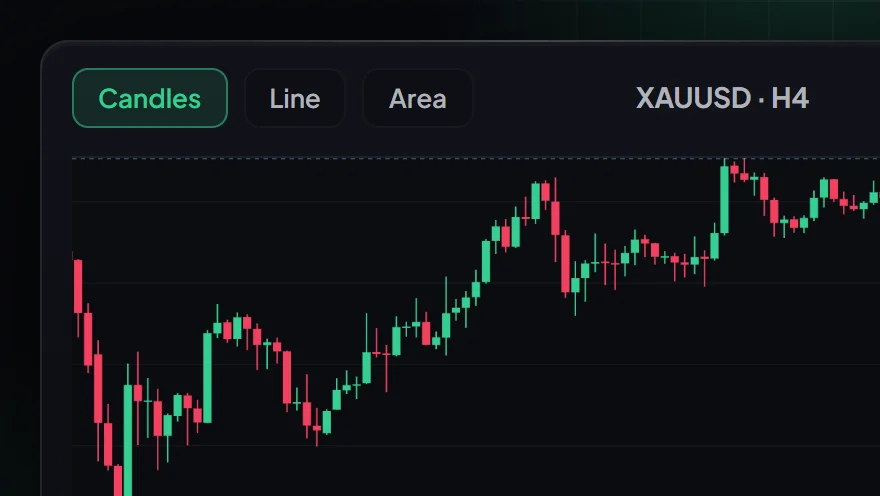
The best XAUUSD trading strategy is the one that fits what gold is doing now (trending, ranging or breaking out) and keeps your worst losing day inside your account's daily loss limit. In practice that means a few written setups, picked by market state and session, with every trade sized from its stop distance in dollars per ounce. Match the setup to the market:
- Gold trending: setup 1, the trend pullback to a moving average.
- Gold ranging: setup 2, the reversal at support and resistance.
- Gold leaving a range: setup 3, the breakout and retest, or setup 4, the Asian range breakout at the London open.
- Gold overstretched without news: setup 5, the M5 mean-reversion scalp, the most cost-sensitive of the five.
What moves XAUUSD, and why gold needs its own strategy
XAUUSD is the price of one troy ounce of gold in US dollars. It moves mainly on the dollar, real interest-rate expectations (gold pays no yield), inflation data, Federal Reserve decisions and safe-haven demand in times of geopolitical stress; the dollar link is usually inverse but not fixed, so treat a dollar chart as context, not an entry signal. Two points shape every setup below. Each dollar of price movement is multiplied by the ounces in one lot, so a stop that looks small on the chart can still be a large loss. And the XAUUSD spread can widen sharply around CPI, Non-Farm Payrolls and FOMC releases and in thin hours, which hits the short-term setups hardest.
The 5 XAUUSD setups, and when each one works
Treat each setup as a hypothesis to test on your own broker's data and costs, not a promise of profit, and write every rule so that two people reading it would place the same order.
1. Trend pullback to the moving average
Use it when: gold is trending on H4 or the daily chart, for example price above a rising 200-period EMA with the 50-period EMA above it (the reverse for shorts). An ADX reading above 25 is a common trend-strength filter.
Entry: a pullback into the 50 EMA (or the 20 EMA on H1), entered only after a candle closes back in the trend direction, such as a bullish engulfing bar or a pin bar rejecting the average.
Stop and target: stop beyond the pullback's swing low (swing high for shorts) plus a buffer; target the prior swing high or a fixed multiple of the risk.
Where it fails: sideways markets, where the averages flatten and price whips through them. If the 50 and 200 EMA are tangled, the setup is off.
2. Range reversal at support and resistance
Use it when: XAUUSD rotates between a clear floor and ceiling on H1 or H4, with several touches on each side. Contracting Bollinger Bands often mark that consolidation.
Entry: sell a rejection at resistance or buy one at support, confirmed by a reversal candle and, optionally, RSI above 70 at the top or below 30 at the bottom.
Stop and target: stop just outside the range boundary, where a breakout proves the idea wrong; target the opposite side, minus a margin so you do not need an exact touch.
Where it fails: when the range breaks. Exit on a decisive close outside the boundary, and never turn a failed range trade into a breakout trade on the fly.
3. Breakout and retest of a key level
Use it when: price has compressed under a clear level, such as the previous day's high or low or a multi-day consolidation, ahead of a session open or a scheduled catalyst.
Entry: mark the level before the break. After a candle closes beyond it, wait for a retest that holds, then enter in the direction of the break. The retest filters out some false breaks at the cost of missing some fast moves.
Stop and target: stop back inside the old range, beyond the retest extreme; target a measured move equal to the height of the range, or the next higher-timeframe level.
Where it fails: late entries. If gold has already run far from the level, the stop is too far away for the size you planned; skip the trade rather than chase it.
4. Asian range breakout at the London open
Use it when: gold has drifted in a quiet range during the Asian session and you can be at the screen for the London open. Gold activity usually picks up with London and again when New York joins; our guide to gold trading sessions covers the hours.
Entry: mark the Asian session high and low before London opens, and enter on a break of either side after the open. Skip ranges that are very narrow (no energy) or already very wide (the move has happened) relative to the Average True Range.
Stop and target: stop on the other side of the Asian range, or at its midpoint for a tighter version; first target one range height projected from the breakout.
Where it fails: days dominated by a later US release, when a London break can reverse once New York trades the data. Check the economic calendar before the open.
5. Mean-reversion scalp on M5
Use it when: price has stretched far from a short moving average on M5 without news behind it, for example RSI above 80 or below 20 after a fast spike.
Entry: wait for momentum to stall (a reversal candle or RSI divergence) and enter back toward the 20 EMA.
Stop and target: stop beyond the spike extreme; target the moving average, not beyond it.
Where it fails: news-driven moves, which do not revert on schedule, and costs. As an illustration, a round-trip cost of $0.30 per ounce against a $1.50 target takes 20% of every winner before slippage. So no XAUUSD scalping settings on the M1 or M5 timeframe stay optimal across brokers: the spread you actually pay decides it, and settings tuned on old data need retesting on current conditions. Our page on gold scalping works through that spread math.
Which is the best strategy for XAUUSD trading? Compare by criteria
The best setup is the one whose conditions match your market, your schedule and your account, judged on these criteria:
| Setup | Market state | Charts | Stop goes | Main risk | Fit on a prop account |
|---|---|---|---|---|---|
| 1. Trend pullback | Trending | H1 to daily | Beyond the pullback swing | Chop around flat averages | Good: few trades, planned stops |
| 2. Range reversal | Sideways | H1, H4 | Outside the range boundary | The range breaks | Good if you exit on the break |
| 3. Breakout and retest | Compression before a catalyst | M15 to H4 | Back inside the old range | False breaks, chasing | Fair: keep size small on news days |
| 4. Asian range breakout | Quiet Asia, active London | M15, H1 | Other side or midpoint of the range | Reversal on US data | Fair: one trade a day keeps risk countable |
| 5. M5 mean reversion | Overstretched, no news | M1, M5 | Beyond the spike extreme | Costs and news spikes | Weakest: many trades, cost-sensitive |
For day trading gold inside one session, setups 3 and 4 fit the schedule; if you check charts a few times a day, setup 1 on H4 suits you better. Trade one setup for a few dozen recorded trades, costs included, before adding a second, or you cannot tell which rule made or lost the money.
How to place a stop-loss for XAU/USD candlestick patterns
Place the stop where the candlestick pattern is proven wrong, add a buffer for spread and noise, and only then work out the position size. For the common patterns on gold:
- Pin bar or hammer: beyond the tip of the long wick. The wick is the rejected price; if it trades again, the rejection failed.
- Bullish or bearish engulfing: beyond the low (for longs) or the high (for shorts) of the engulfing candle, not of the small candle it engulfed.
- Inside bar breakout: beyond the opposite side of the mother bar.
- Doji at a level: beyond the level or the doji's extreme, whichever is further away.
Then add the buffer. A fixed few cents is too small on gold; a common approach is 0.2 to 0.5 of the Average True Range of the chart you trade. For a short, also add the spread: MT4 and MT5 charts show the bid price, while a sell position is closed at the ask. Avoid parking the stop exactly on a round 50 or 100 dollar handle, where orders cluster. If the resulting stop is too wide for your risk budget, trade a smaller position or skip the trade; never pull the stop inside the noise.
Position sizing for gold: a worked example
Brokers quote gold with different decimals, and the word pip means different things on different XAUUSD symbols, so do the maths in dollars per ounce. Open the symbol specification in MetaTrader and note the contract size, the minimum volume and the volume step.
Illustrative example, not a recommendation: a $100,000 account, a risk budget of 0.5% per trade ($500), a symbol whose specification shows 100 ounces per lot, and a pin-bar long with the stop $6.00 below the entry.
- Loss per 1.00 lot if the stop is hit: $6.00 × 100 ounces = $600.
- Position size: $500 / $600 = 0.833 lots, rounded down to the volume step: 0.83 lots.
- Planned loss at the stop: 0.83 × $600 = $498, before spread, commission and slippage.
- With a 1:2 target, the price goal is $12.00 above the entry, a planned gain of about $996 before costs.
Rounding down and counting costs inside the budget keep the loss per trade where you planned it, though a gap through the stop or slippage around news can still make it larger: a stop order is an instruction to close, not a guaranteed fill price.
What take-profit ratio works on XAUUSD?
Put the take-profit where the chart supports it (the prior swing, the other side of a range or a measured move) and let the reward-to-risk ratio follow from that; no fixed ratio is ideal on gold. That ratio tells you how often the setup must win just to break even. Before costs:
| Reward to risk | Break-even win rate before costs |
|---|---|
| 1:1 | 50% |
| 1:1.5 | 40% |
| 1:2 | 33.3% |
| 1:3 | 25% |
Costs push every break-even rate higher, most of all for small targets, which is why the setup 5 scalp usually needs a higher hit rate than the trend pullback. A larger ratio is not automatically better: a 1:3 target that price rarely reaches can earn less than a 1:1.5 target at a nearby level. A common compromise is a partial profit at the first level and a trailing stop on the rest.
Running a gold strategy on a prop-firm account
On a challenge or funded account, the account rules decide more than the entry signal.
Which prop firms allow XAUUSD?
Gold is commonly offered as a CFD symbol by forex prop firms that run MetaTrader accounts, but the symbol list, its trading hours and the rules around it are set per firm and per product. Confirm XAUUSD, or a variant name such as GOLD, on the instrument list of the exact account you plan to trade; our prop firm directory is a place to start that comparison.
Once gold is listed, the loss limits decide how you can trade it. As of October 2026, FTMO sets a 5% daily and a 10% maximum loss (static) on its 2-Step challenge, and 3% daily and 10% maximum (end-of-day trailing) on its 1-Step, so a gold stop that fits one product can be too large for the other. News restrictions, overnight or weekend holding and EA permission also differ by firm and product, which matters for a setup that holds through CPI or runs on an EA.
Daily risk management for gold on a prop account
The most practical daily risk management solution for gold is a personal daily stop set well below the firm's limit and measured the way the firm measures it, open trades included. An example for a $100,000 account with a 5% daily limit ($5,000) and the $500 risk per trade from the sizing example:
- Stop for the day after two consecutive losses or $1,500 of loss for the day, closed and open trades together, whichever comes first. That leaves room for slippage and for a trade still open when the day turns.
- Count the risk of open positions, not just closed losses: two open gold trades with $500 each at risk are $1,000 of exposure toward the daily limit.
- Do not add size to win back a loss on the same day, and stand aside or cut size around scheduled US data your setup was not designed for.
Our guide to prop firm drawdown rules explains daily versus maximum drawdown in more detail.
Trading psychology for a volatile market like gold
Gold's fast moves invite the classic mistakes: widening a stop, doubling size after a loss, chasing a breakout that has already run. The fix is mostly mechanical. Write the setup, stop, size and daily stop before the session, log any trade outside the plan as an error even when it wins, and review a journal (setup, reason, stop, result, costs, how you felt) every week. Automation can execute written rules consistently, but a person still chooses the rules, monitors the account and switches it off when conditions change.
Automating a gold setup on MT4 or MT5
An Expert Advisor repeats the rules it is given, including bad ones. Before you run one on XAUUSD, check that it has:
- session or time filters that match the setup, for example London and New York only for setups 3 and 4;
- a news pause, or a written rule to switch it off around high-impact US releases;
- a daily loss stop that counts open positions the way your account rule does;
- a maximum spread filter, so it skips entries when the gold spread is wide;
- position size computed from the stop distance and the symbol's contract size, not a fixed lot.
Test it on your own broker's gold data with realistic spreads. A backtest is not proof of compliance with a firm's current rules, and automation can still fail through disconnections, slippage or rule changes. Whether you may run an EA at all is set per firm, and sometimes per account size, so read the EA rules of your exact account first.
The EA Hub on a gold account. The JPTC EA Hub is an MT4/MT5 Expert Advisor licence with configurable setfiles that you download and run on your own terminal, on a reliable PC or VPS; JPTC does not host it. It is built around prop-firm risk rules: enabled limits can stop new entries and request closure of open positions, but they cannot guarantee an execution price or prevent every breach. A firm preset or name is not proof of compatibility or approval, so check the setfile's documentation against your exact account and confirm that the file you buy documents a gold setting rather than assuming one. The software cannot guarantee a pass, a payout or profit, and it is not for Topstep or Apex.
Gold calls instead of software. Our forex and gold signals give an entry, a stop loss and targets for each call, which you can follow manually or copy to your own broker account through supported automatic copying under agreed risk settings and permissions. There is no monthly VIP fee: VIP signals are free to the customer only through an account at a partner broker. The calls are company-published, not an independent audit, and profits are not guaranteed.
Automation on your own broker account. For automated trading on your own broker account rather than a prop account, JPTC runs a separate hosted Algo on its own infrastructure and connects it to your account, with nothing to install and no VPS. It has no promised return and is not offered for prop-firm evaluations. If you trade gold by hand, none of these replaces the five setups above.
Trading gold on MT4 or MT5 and want daily loss controls you set on your own terminal? See the JPTC EA Hub →
FAQ
Is there a successful or profitable XAUUSD strategy?
What is the best timeframe for XAUUSD?
Is XAUUSD good for beginners?
Related Articles
- Forex Trading Bots: Automate Your Strategy · Read more →
- Forex Bot Trading: Master Automated Prop Firm Challenges · Read more →
- Forex Trading Bot: Your Automated Profit Partner · Read more →
- Forex Trading Bot AI: Master Prop Firms & Maximize Profits · Read more →
- Forex Trading Bot for Android: Your Guide · Read more →
- Forex Trading Bot GitHub: Your Open-Source Guide · Read more →
- Forex Trading Bot MT5: Your Prop Firm Edge · Read more →
Automated forex and gold trading
Runs on your own account at your own broker. We host and set it up, so there is nothing to install and no VPS. No profit share, no monthly fee.
See how it works