Prop Firm Risk Management: The Complete Guide

Prop firm risk management is the system of rules and calculations that keeps your funded account alive long enough to prove profitability. It combines strict daily loss limits, maximum drawdown caps, position sizing discipline, and trade-entry logic into a single framework that protects both the firm's capital and your equity. Without it, most traders blow accounts within weeks.
- Daily drawdown limits typically range from 5 to 10% of starting capital
- Maximum loss per trade should not exceed 1 to 2% of account equity
- Lot sizing is the single largest controllable variable in your success rate
- Automated EA execution removes emotion and ensures rule compliance
- Backtesting against firm rules before trading live is non-negotiable
Why is prop firm risk management different from retail trading?
Prop firm risk management differs from retail trading because the firm enforces the limits for you and a single breach ends the account, with no time to recover the loss over following months. Retail traders often manage risk loosely: some risk 5% per trade, some 10%, some don't calculate at all, and prop firms can't afford that variability. FTMO's official rules page specifies that any breach of daily drawdown limits results in immediate account termination, no second chances. This isn't a suggestion, it's a hard stop.
The framework is fundamentally different because:
- Evaluation periods are short. You have 30 to 60 days to prove consistency. One bad week can mean failure. In retail, you can take losses and recover over months.
- Drawdown rules are absolute. Hit a 5% daily loss in a prop account and your trading day ends. In retail, you can keep going.
- Consistency matters more than profit. Prop firms want steady, repeatable returns. A single 20% win followed by a 15% loss looks worse than ten 2% wins, even if the net P&L is identical.
- Risk per trade is capped by the firm, not just by you. Your leverage is fixed, your margin rules are preset, and your stops are monitored.
How do drawdown rules work in a prop firm challenge?
Drawdown rules in a prop firm challenge cap the peak-to-trough decline allowed in your account equity, and the firm enforces the cap rather than leaving it to you. Most prop firms enforce two types:
Daily Drawdown (the hardest limit)
This is how much you can lose in a single trading day before your account locks. On FTMO's account tier page, the rule is consistent: 5% daily drawdown cap across all account sizes. Lose $2,500 on a $50,000 account in one day, your trading halts until the next day. It resets daily.
The daily drawdown rule forces discipline into entry and exit logic. Traders who skip this and trade on hope, holding losing positions overnight, averaging down, or revenge trading, blow their accounts fastest.
Maximum Loss (the ultimate stop)
This is the total equity loss allowed across the entire evaluation period. FTMO allows 10% maximum loss. Hit that and you're out, evaluation failed. FundedNext and other prop firms use similar structures, though the exact percentages vary.
What makes this different from retail: in retail, a 10% loss is just a bad month. In prop, it's a hard fail. This reality shapes everything: position sizing, strategy selection, even which currency pairs you trade.
How much should I risk per trade at a prop firm?
Risk per trade at a prop firm should stay between 0.5 and 1% of account equity, which is a maximum of $500 on a $50,000 account. Risk per trade is the amount of equity you expose to a single trade, and this is where most traders fail, because they confuse percentage with dollar amounts.
The 1% Rule and Why It Works
The 1% rule states: never risk more than 1% of your account equity on a single trade. On a $50,000 account, that's $500 maximum risk per trade. If your stop loss is 50 pips and you're trading EUR/USD (where one pip = ~$10 per standard lot), your position size cannot exceed 1 lot.
This isn't arbitrary. Here's the math:
- $500 risk ÷ 50 pips = $10 per pip
- EUR/USD at 1 standard lot = ~$10 per pip
- Position size: 1 lot
If you breach this, say, you risk 3% because you're confident in a setup, a losing streak of 4 to 5 trades will hit your daily drawdown limit and lock your account.
Why 1% is Better Than Higher Risk for Prop Firm Challenges
Some retail traders risk 2 to 3% per trade and call it acceptable. For prop firm evaluations, this backfires because:
- A 5-loss streak costs 5 to 15% of your account (dead account)
- You have no buffer for consecutive losses, which happen to every strategy
- The daily drawdown cap becomes a wall you hit too often
The JPTradingCapital Team's analysis of live funded accounts shows traders who keep risk to 0.5 to 1% per trade have 3 to 4x higher evaluation pass rates than those risking 2%+. Lower risk per trade = longer runway = more opportunities to prove profitability.
How do I calculate lot size for a prop firm account?
Calculate lot size for a prop firm account with the formula (Account Equity × Risk %) ÷ (Stop Loss in Pips × Pip Value), recalculated from current equity before every trade. A lot size calculator translates your risk tolerance into actual position sizes. Without one, you're guessing. With one, you're following a formula that can be automated.
The Basic Lot Size Formula
Lot size = (Account Equity × Risk %) ÷ (Stop Loss in Pips × Pip Value)
Example:
- Account equity: $50,000
- Risk per trade: 1% = $500
- Stop loss: 30 pips
- Currency pair: EUR/USD (pip value = $10 at 1 standard lot)
Lot size = ($50,000 × 0.01) ÷ (30 × 10) = $500 ÷ $300 = 1.67 standard lots
Round down: 1.5 lots (be conservative; don't round up)
Why This Matters for Prop Firm Rules
When you manually calculate lot size, you can do it right once per trade. When you have 20 trades per day, you'll make mistakes. This is where automated tools shine. The JPTC EA Hub includes built-in lot size calculators that respect firm drawdown rules in real time. It calculates position size based on current equity (which changes with each closed trade), account rules, and your stop loss before the trade even opens.
The alternative, using a fixed lot size or eyeballing it, causes you to either undersize (leaving money on the table) or oversize (blowing the account).
What are the three layers of forex money management?
Forex money management has three layers: position sizing on every trade, a daily loss limit, and a maximum loss cap across the evaluation period. Money management in forex isn't just position sizing, it's a three-layer system that works together to keep you in compliance with prop firm drawdown rules.
Layer 1: Position Sizing (Risk Per Trade)
We've covered this: 0.5 to 1% per trade, calculated with a lot size calculator. This is the tightest control because it applies to every single trade.
Layer 2: Daily Loss Limits (Daily Drawdown Monitoring)
Once you've hit your daily drawdown limit (5% for FTMO, varies for others), you must stop trading. Not "stop risking," stop trading completely. This is non-negotiable and automated in any proper system.
Example: $50,000 account, 5% daily limit = $2,500 max loss per day
- Trade 1: Lose $300 (6% of daily limit left)
- Trade 2: Lose $400 (4.4% of daily limit left)
- Trade 3: Lose $800 (2.8% of daily limit left)
- Trade 4: Lose $600 (2.0% of daily limit left)
- Trade 5: Loss size would be $1,200. Stop. You're done for the day.
Without this, traders rationalize "one more trade" to break even and blow the entire week's drawdown limit in one morning.
Layer 3: Monthly / Evaluation Loss Limits (Maximum Loss Cap)
This is the ultimate guardrail. On FTMO, it's 10% cumulative loss across the evaluation period. This forces you to adapt your strategy if you're in drawdown. If you're at 7% loss with 2 weeks left, your risk per trade must drop. Your lot size adjusts automatically (if using a proper calculator), or you skip days, or you reduce exposure.
The three-layer system is why automated systems like the JPTC EA Hub work: they monitor all three limits simultaneously and adjust or halt trading when needed. Manual trading almost always fails because traders optimize for the next trade, not the next month.
How do I backtest a strategy against prop firm rules?
Backtest a strategy against prop firm rules by re-running it with the daily drawdown limit and the maximum loss cap active, so the test blocks the trades the firm would have blocked. Before you ever fund an account, you must backtest your strategy with prop firm drawdown rules baked in. This means:
- Run backtest with 5% daily drawdown limit active (if a daily loss exceeds 5%, the rest of that day's trades are disallowed)
- Check for 10% maximum loss breaches across the entire backtest period (equal to your evaluation window)
- Use the exact lot size formula with live pip values for your pairs
- Test across multiple market regimes (trending, ranging, high volatility, low volatility)
Most strategies that look profitable in standard backtests fail when you apply drawdown rules because the rules prevent you from staying in the big winners and catching the trend reversals.
The JPTradingCapital Team backtests all EA strategies in the JPTC EA Hub with firm rules pre-applied. You see real-world pass/fail rates because the backtest reflects actual prop firm constraints, not theoretical "buy and hold" scenarios.
Common Prop Firm Risk Management Mistakes
Mistake 1: Ignoring Daily Drawdown Until It Happens
Traders assume they won't hit their daily limit because "my strategy doesn't have 5-loss streaks." Then it does. A single difficult market day, news event, volatility spike, gap open, breaks your streak and you panic trade, which breaks your system entirely.
Solution: Assume it will happen and automate the halt. If your system can't stop itself at the daily limit, upgrade to one that can.
Mistake 2: Overleveraging on "High-Confidence" Setups
A setup looks perfect. You risk 2% instead of 1%. It loses. Now you're in a hole before noon. Confidence has no place in position sizing; only math does.
Solution: Use the lot size calculator for every trade, no exceptions, no overrides.
Mistake 3: Revenge Trading After a Daily Loss
You lost $1,000 this morning. You have $1,500 left in your daily drawdown buffer. You're tempted to make a bigger bet to get it back. This almost always fails because your psychology is compromised.
Solution: If you hit 50%+ of your daily drawdown limit, lock in your lot size at a lower value or stop trading for the day. The account will recover tomorrow.
Mistake 4: Not Adjusting Risk When Equity Changes
You start with $50,000. After a week of losses, you're at $48,000. Your lot size should drop because your 1% is now $480, not $500. Many traders forget this and keep using the original lot size, which becomes 1.04% risk.
Solution: Use a calculator that recalculates every trade based on current equity, not starting equity.
What tools automate prop firm risk management?
Prop firm risk management is automated with MetaTrader 4 and MetaTrader 5 Expert Advisors, which size positions from current equity, block trades at the daily drawdown limit and halt trading when the maximum loss is breached. Risk management at scale, tracking limits, adjusting position sizes, halting at drawdown caps, requires automation. Spreadsheets work for 10 trades. Not for 100.
MetaTrader and EA-Based Risk Management
MetaTrader 4 and MetaTrader 5 are the platforms all major prop firms support (FTMO, FundedNext, FXify, TopStep). They support Expert Advisors (EAs) that can automate risk management completely.
An EA can:
- Calculate lot size in real time based on current equity and stop loss
- Block trades if daily drawdown limit is reached
- Halt trading if maximum loss is breached
- Reduce position size if equity drops below a threshold
- Log every trade with risk metrics for review
The JPTC EA Hub Advantage
The JPTC EA Hub is pre-configured with prop-firm-ready strategies and built-in risk management. Every EA in the hub:
- Respects daily drawdown caps (FTMO 5%, FundedNext rules, etc.)
- Enforces maximum loss limits across the evaluation period
- Uses dynamic lot sizing tied to current equity
- Has backtested performance across multiple market conditions
- Works on both MT4 and MT5
- Integrates with all major prop firms in seconds
This removes the guesswork and the emotional override. You can't manually override a hard-coded rule.
our results page and Track Record Verification
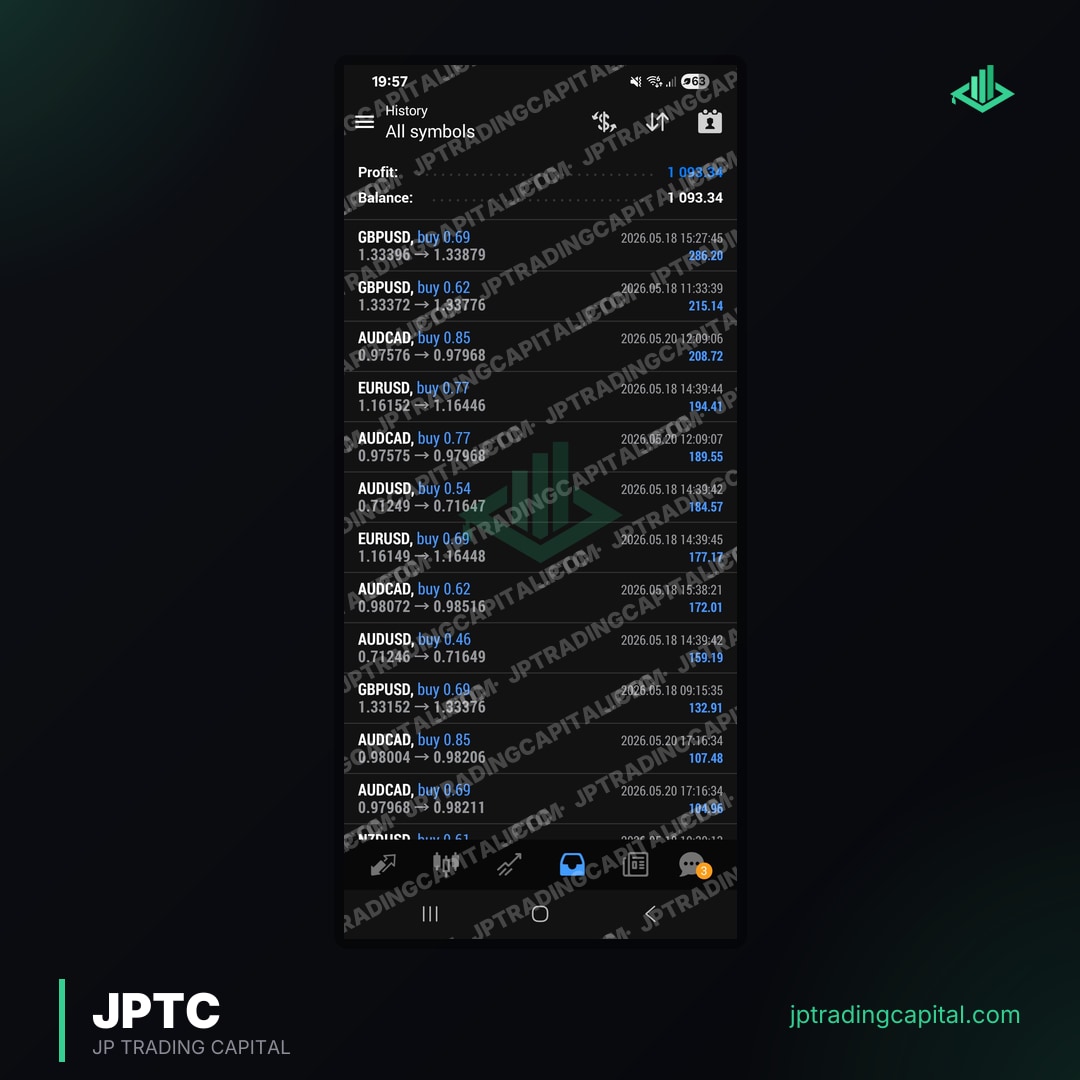
Once you're trading live, our results page is the standard for public track record verification. It syncs with your MT4/MT5 account and creates a live, verified statement that every broker and prop firm trusts.
For affiliate partners and EA developers, our results page statements are the proof of performance. If you're selling an EA or promoting a strategy, a published results with live results and consistent drawdown management is the best credibility builder.
Do prop firm drawdown rules differ between firms?
Prop firm drawdown rules differ slightly between firms, though the general framework is the same: a daily drawdown cap plus a maximum loss cap across the evaluation. Know your firm's rules before you start.
- FTMO: 5% daily drawdown, 10% maximum loss
- FundedNext: 5 to 6% daily drawdown (varies by tier), 10% maximum loss
- FXify: Typically 5% daily, 10% maximum (verify on their platform)
- TopStep: Combines daily and maximum loss rules; check their official rules
- The5ers: Similar structure, 5% daily, 10% maximum
If you're running an EA across multiple firms, your risk management settings must be conservative enough to pass the strictest rules across all platforms. In practice, this means targeting the tightest limit (5% daily, 10% maximum) and your account will comply everywhere.
FAQ





What is prop firm risk management, and why is it different from retail forex?
What is the recommended risk per trade for prop firm challenges?
How do daily drawdown limits work in prop firms like FTMO?
What should I use to calculate lot sizes for prop firm trading?
Can I use an EA to manage prop firm risk automatically?
Final Thoughts: Risk Management is Your Edge
In prop firm challenges, risk management separates the 10% who pass from the 90% who fail. It's not about having the perfect strategy; it's about managing drawdown so intelligently that you stay in the game long enough for your strategy to prove itself.
The traders who succeed:
- Follow a lot size formula, never eyeballing it
- Respect daily drawdown limits like they're law (because they are)
- Automate their rules so they can't override them under pressure
- Backtest with drawdown caps enabled
- Adjust position size as equity changes
You can have a mediocre strategy with excellent risk management and pass evaluations. You cannot have an excellent strategy with poor risk management and survive. Build your system around risk first, and profit follows.
Related Articles
- Apex Trader Funding vs TopStep: Which Futures Prop Firm Is Best in 2026? · Read more →
- How to Choose the Right Prop Firm in 2026: Complete Selection Guide · Read more →
- Can a Trading Bot Pass a Prop Firm Challenge on XAUUSD (Gold)? · Read more →
- Prop Firm Trading Without Leverage Restrictions: How to Scale Safely in 2026 · Read more →
- Is Prop Firm Trading Worth It? Honest Review (2025 Data) · Read more →
- Trade Copier Explained: The Ultimate Guide for Prop Firm Traders in 2024 · Read more →
- Trade Copier Explained: Automate Your Prop Firm Accounts · Read more →
- Prop Firm Challenge Passing Rate by Strategy: Statistical Analysis of What Actually Works · Read more →
The EA built for prop firm rules
Daily drawdown guard, hard max-loss stop, consistency-aware pacing and a news pause, on MT4 and MT5. One-time €797, no monthly fee. If you would rather not run the evaluation yourself, we run it for you.
See the EA Hub