How Long Does a Prop Firm Challenge Take? Days and Review Time
Material update: 15 October 2026: specifically identified source references, unsupported own-product/result qualifications or account-rule wording corrected. Existing publication status and URL retained.

There is no verified industry average established here for how long a prop firm challenge takes. A programme’s minimum trading days can set a condition for completion, but they do not predict when you will reach every objective. Calendar time, rule checks, review and later payment are separate parts of the process.
Count the right kind of day
For the exact product and phase, record the source and rule version, what qualifies as a trading day, its time zone, any minimum, deadline or inactivity rule, and when a review begins. A day with an open position is not necessarily a qualifying day: use the programme’s definition. “Unlimited time” does not mean the other conditions disappear.
Checked on 15 October 2026 UTC: FTMO’s CFD 2-Step objectives require four trading days in each evaluation phase and define a day by opening at least one position within the CE(S)T day. The profit target requires closed positions. These are conditions for that product, not four days to complete every FTMO product or an average trader’s result. The same source distinguishes consistency rules by product and, for 1-Step, order/merge date.
A timeline worksheet
Entirely fictional programme and schedule. Not FTMO rules, a service turnaround or a prediction. Assume phase A requires three qualifying days, phase B requires two, and the phases do not overlap.
| Calendar marker | Recorded event |
|---|---|
| Days 1, 3 and 5 | Three qualifying phase-A days; assume all other A conditions are satisfied on day 5. |
| Days 6–7 | Assumed review/transition interval; no qualifying phase-B day counted. |
| Days 8 and 11 | Two qualifying phase-B days; assume its remaining conditions are satisfied on day 11. |
That is five qualifying days across phases over an eleven-calendar-day window, counting day 1 through day 11 inclusively. It is not five consecutive days. A holiday, missing setup, changed review interval or unfulfilled condition changes the schedule. A subsequent account or first Reward has separate requirements; neither is included in this example.
Why target divided by a daily gain is not a forecast
Dividing a target by an assumed daily profit treats the profit as a fixed input. Actual gains, losses, no-trade periods, costs and rule constraints do not form that schedule automatically. Account size or more frequent orders alone does not establish a quicker pass. Increasing exposure to meet a calendar target changes risk; it does not validate the target date.
A missed target, inactivity condition and loss-limit breach are different events. Check the documented consequence rather than assume a reset, extension or free retry. A completed evaluation is also different from keeping the subsequent account or receiving a payment.
Read duration statistics with the unfinished attempts included
Fictional six-attempt dataset at a reporting checkpoint. Three attempts completed after 10, 20 and 30 days; one failed after 5; two remain open with 25 and 40 days observed. The median of the three completed durations is 20 days. Only three of six starts have completed by the checkpoint. The completed-only median does not mean all six starts pass in 20 days; open attempts are unfinished observations, not automatically failures.
A credible duration report states the programme/version, start and end event, calendar or trading-day basis, observation period, failures, open cases and repeated attempts. A selected fast-pass screenshot or a firm’s minimum-day rule is not that dataset.
Plan the next review instead of promising a finish date
- Before starting: save rule/version dates, day definitions, all completion conditions and maximum spending.
- At each session: update qualifying days, remaining conditions, account loss room and planned exposure.
- At a review point: reconcile statement and journal; distinguish a missing setup, execution issue and rule incident.
- Before another paid attempt: reassess the cause and cumulative cost. Do not assume future payment funds a renewal.
The checklist makes progress visible without imposing a daily return or a fixed risk percentage. A backtest, practice record or consistent routine does not establish your completion time.
Tools do not establish a shorter timeline
No measured speed advantage is established here for the JPTC EA Hub. Check exact-version behaviour, test conditions and programme permission. FTMO’s personal-use rules and The 5ers’ management/EA restrictions do not support universal assurances about copying or third-party services.
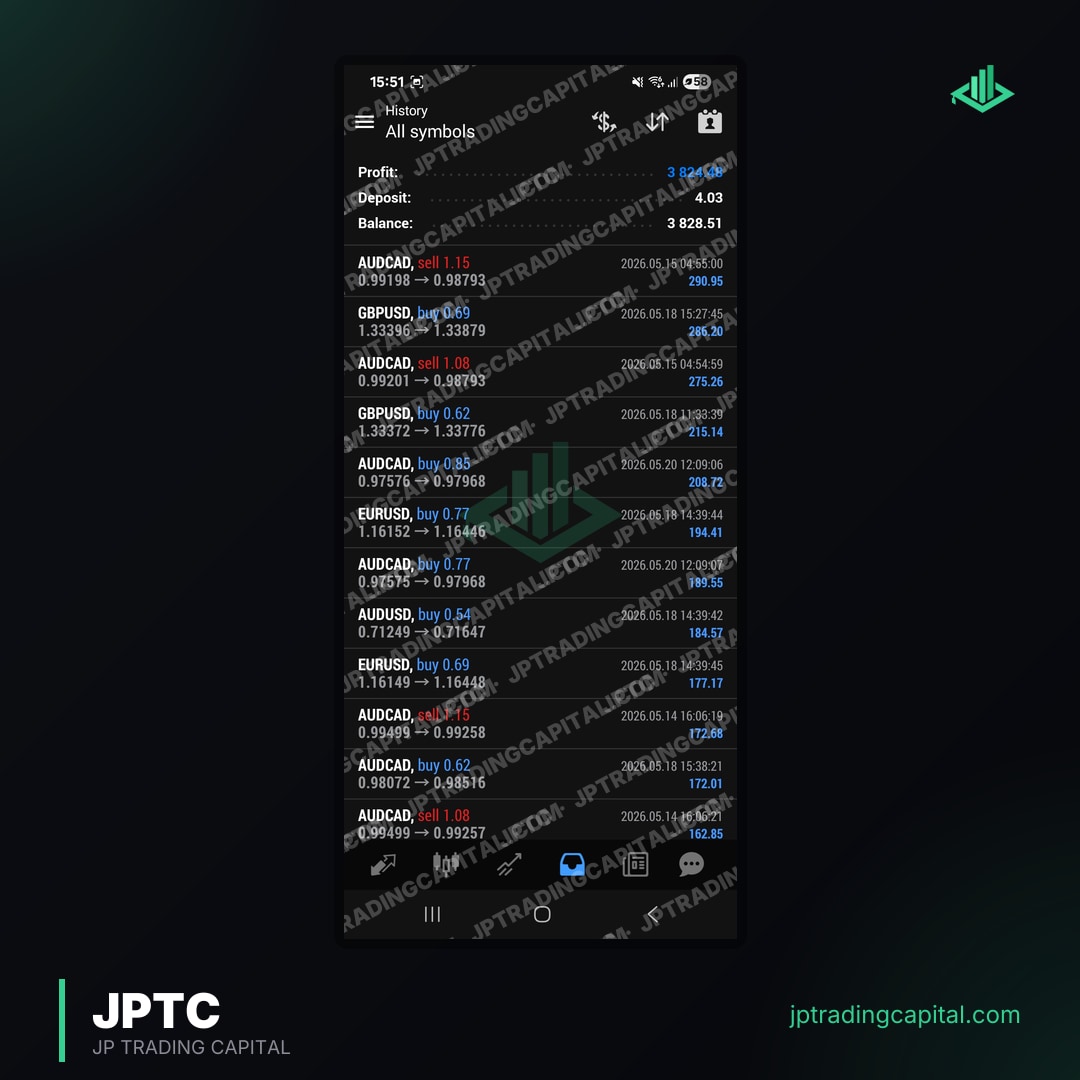
The separate hosted JPTC Algo is not offered for prop evaluations; its customers install or run nothing and need no VPS. JPTC’s company broker-statement figures are not an independent audit, a challenge-duration study or proof of what your account will do.





Is the minimum number of trading days the expected passing time?
Is there a verified industry average in this guide?
Can I turn a target and an assumed daily gain into a finish date?
Does buying an EA establish a faster pass?
Review the JPTC EA Hub
EA software with version-specific documentation and account-level risk controls. Review the selected programme’s current automation rules and test the chosen version; software does not guarantee compliance, a pass or a payout.
See the EA Hub