Prop Instant Trading: Costs, Risk Rules, and Trade-Offs
Prop instant trading allows traders to skip multi-stage evaluation challenges and begin trading a simulated funded account immediately upon paying an activation fee. While bypassing profit targets sounds like a shortcut to payouts, direct funding shifts the mathematical edge heavily toward the prop firm through elevated fee structures, compressed drawdown buffers, and restrictive consistency rules. Traders considering this route must evaluate whether paying premium prices for minimal loss tolerance serves their trading strategy better than traditional evaluation paths or running automated strategies on personal broker accounts.
Before committing capital to an instant account, review these core operational realities:
- Compressed risk capital: While you receive a large nominal balance, your actual trading buffer is limited strictly to the firm maximum drawdown limit.
- Aggressive consistency rules: Direct funding programs frequently cap the percentage of total profit allowed on a single trading day to prevent payout spikes.
- Elevated costs per dollar of drawdown: Upfront fees for direct funding are significantly higher per dollar of permitted loss than standard evaluation tiers.
- Strict automation limitations: Many prop firms restrict or ban external trading algorithms and third-party software on instant accounts.
What Is Prop Instant Trading and How Does It Work?
Prop instant trading, frequently marketed as instant funding or direct funding, bypasses standard Phase 1 and Phase 2 evaluation challenges. Instead of requiring a trader to hit an 8% or 10% profit target within a simulated environment, the firm issues active simulated credentials immediately after the purchase is complete. Payouts become accessible after satisfying a holding period or a minimum number of trading days, subject to compliance with the firm risk objectives.
All accounts provided by modern prop firms, including FTMO and FundedNext, operate within a simulated trading environment. For example, the FTMO comparison table outlines that its Instant model begins from EUR 169 with a 90% profit split, compared to its 2-Step challenge starting from EUR 89 and its 1-Step challenge starting from EUR 79. On all FTMO models, trading takes place on simulated accounts where market performance determines payout eligibility.
The central appeal of instant trading is psychological: it eliminates the pressure of chasing a profit target before a deadline. However, this convenience comes at a steep price. Because the firm absorbs payout liability from day one without vetting trader execution skills through a challenge, it compensates by enforcing severe risk boundaries that make longevity difficult for aggressive traders.
The True Cost of Instant Funding: Drawdown vs Balance
The primary marketing figure of any prop firm is the headline account balance, such as a $10,000 or $50,000 account. In prop instant trading, this headline balance is largely irrelevant. The only number that dictates your operational reality is your maximum drawdown limit, which represents your true risk capital.
Consider a standard mathematical comparison between a 2-Step evaluation and an instant funding account:
- FTMO 2-Step 10K Account: The entry fee is EUR 89. The trader has a 10% maximum static loss limit ($1,000) and a 5% daily loss limit ($500). The fee per dollar of maximum risk buffer is roughly EUR 0.089 per dollar.
- FTMO Instant 10K Account: The entry fee starts at EUR 169. While providing direct access to a 90% profit split, the trader pays nearly double the entry cost upfront for simulated capital that carries immediate forfeiture risk if standard drawdown boundaries are touched.
When you purchase an instant account, you are effectively paying a premium fee for a small, unforgiving buffer. If a trader risks 1% of the nominal balance per trade ($100 on a $10,000 account), a string of five consecutive losses will breach a 5% maximum limit, terminating the account and forfeiting the entire fee. In contrast, evaluation models give traders a larger cumulative loss allowance relative to the fee paid.
Hidden Traps: Consistency Rules and Loss Calculations
The most overlooked hurdle in prop instant trading is the consistency rule. When traders do not have to pass a profit target, prop firms implement strict statistical boundaries to ensure that trader returns are distributed across multiple trading sessions rather than resulting from a single high-risk gamble.
Under official FTMO trading objectives, Instant accounts enforce a 30% consistency rule. This means that a trader best single trading day may generate at most 30% of their total accumulated profit. If a trader makes $1,000 total profit on an instant account, but $400 of that profit came from a single volatile session, the trader fails the consistency metric and cannot request a payout until further trading balances the distribution.
By comparison, FTMO 2-Step accounts do not enforce a consistency target, while 1-Step accounts ordered or merged from 12 October 2026 require that the best trading day represents at most 50% of total profit (which replaced the earlier Best Day Rule). On instant funding models, the 30% rule forces traders into a continuous low-volatility grind, punishing momentum traders who capitalize on periodic market breakouts.
Additionally, drawdown tracking mechanisms differ sharply across account models:
- Static Drawdown: Measured from the initial balance. If you start with $100,000 and have a 10% static loss limit, your account is breached only if equity drops below $90,000.
- Trailing Drawdown: Trails your peak balance. FTMO 1-Step accounts employ an end-of-day trailing maximum loss limit of 10% alongside a 3% daily limit. In trailing environments, profits lock in higher account watermarks, permanently shrinking the allowable drawdown from high-water equity.
Can You Run Expert Advisors on Instant Accounts?
Traders who rely on automated software to manage trade execution and stop losses often assume they can deploy their algorithms across any prop firm. In practice, automated trading policies on instant and evaluation accounts are highly fragmented.
FundedNext provides a clear example of these shifting rules. Founded in March 2022, FundedNext offers CFD models including Stellar 2-Step, Stellar 1-Step, Stellar Lite, and Stellar Instant (its Express and Evaluation models were officially closed to new clients and withdrawn on 18 March 2025). On FundedNext CFD accounts, automated trading using expert advisors is permitted only on MT4 or MT5 accounts below $50K, and requires a usage fee for third-party EAs. Furthermore, EAs specifically designed to exploit demo latency or pass challenges are strictly banned, as detailed in the FundedNext help centre.
Other major firms enforce complete prohibitions on third-party algorithms:
- The5ers prohibits third-party automation across its entire platform, requiring traders to execute manually or build proprietary code from scratch. On its High Stakes evaluation model, profit targets are 10% in Phase 1 and 5% in Phase 2, with a 5% daily loss and 10% maximum loss limit.
- Apex Trader Funding bans automated trading entirely across all account types.
- Topstep operates exclusively on TopstepX, with no access to MT4, MT5, or MetaTrader. Bots are permitted only through the paid TopstepX API running directly from the trader own device without VPS support.
Because automation repeats implemented instructions without discretion, market slippage or rapid spreads can still breach strict daily loss limits. No software can ensure or guarantee compliance with dynamic prop firm rules.
Deciding the Right Capital Path: Four Practical Routes
Choosing how to fund your trading requires matching your execution style against the rules and financial commitments of each structure. Here is how professional traders assess the trade-offs:
1. Prop Instant Trading (Direct Funding)
This path suits disciplined, low-risk discretionary traders who have predictable daily returns, understand how to pace their profits to satisfy a 30% consistency rule, and prefer to avoid evaluation targets. However, you must accept high entry fees for narrow drawdown limits and the risk of losing your entire fee on a brief drawdown streak.
2. High-Allocation Evaluations with Structured Preparation
Traders aiming for substantial capital, such as $100,000 or $200,000 accounts, typically choose traditional 2-Step challenges. The entry fees are significantly lower relative to the $10,000 loss buffer, and accounts do not suffer from the restrictive 30% single-day profit cap seen on instant accounts. For traders who struggle with daily loss limits or consistency rules during evaluations, our prop-firm challenge passing service manages the challenge process directly on accounts of $100K and above. The account remains in your name, and the service runs until the challenge is passed. While no one can promise a challenge pass and firm-terms risk sits with the trader, it provides an alternative for traders targeting large allocations without paying exorbitant instant fees.
3. Running Controlled Automation on Your Own Terminal
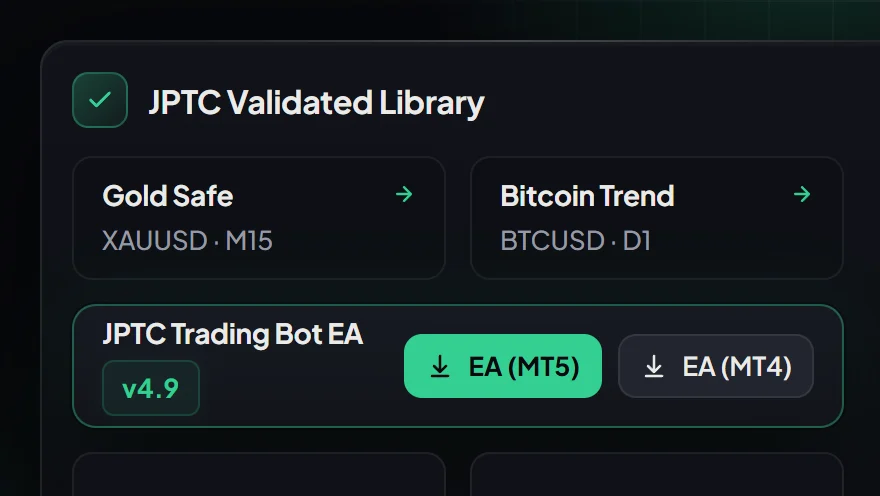
If you prefer to execute algorithmic strategies on MT4 or MT5 prop accounts that permit automated trading, you need software configured around prop-firm drawdown rules. The JPTC EA Hub and EA Hub Pro provide expert advisor software that you purchase once, download, and run on your own MT4 or MT5 terminal. You can operate the software on a reliable PC or VPS (a VPS is an option where your firm permits it, not a requirement). The software includes configurable setfiles designed around prop risk parameters. It is not hosted by JPTC, and results are not guaranteed, but it puts execution parameters directly under your control on supported platforms.
4. Growing Personal Capital on Your Own Broker Account
Many traders eventually tire of prop firm rule changes, trailing drawdown traps, and consistency calculations altogether. Trading on your own broker account removes third-party operational restrictions entirely. For this pathway, JPTradingCapital provides two distinct options:
- The JPTC Hosted Live Algo: Hosted by JPTC on our own infrastructure, this service connects directly to your personal broker account with nothing to install and no VPS required. A minimum account balance applies. It is built strictly to grow personal broker accounts and is not offered for prop-firm challenges, evaluations, or funded accounts. Results are not guaranteed, but a 14-day money-back policy applies if the Algo is not connected and running on your account as shown. We publish monthly figures taken directly from company broker statements at /results; these records reflect broker reporting rather than an independent audit.
- Forex and Gold Calls: Traders who prefer following established market setups receive detailed entry, stop loss, and target levels for forex and gold pairs via our forex and gold signals. The service includes supported automatic copying to your personal broker account under agreed risk parameters and permissions, or trades can be placed manually. There is no monthly VIP fee when accessing eligible tiers through our partner broker.
Frequently Asked Questions About Prop Instant Trading
Is prop instant trading conducted on a real account?
No. Major prop firms operate instant trading accounts in simulated environments. Firms like FTMO and FundedNext use simulated accounts to track performance. Payouts are disbursed according to the firm commercial terms based on simulated profits, meaning your trades are not executing directly on interbank market liquidity.
Why do instant funding accounts enforce strict consistency rules?
In evaluation models, the firm evaluates your consistency over dozens of trades before approving payouts. In prop instant trading, the firm assumes payout exposure immediately. To protect against windfall profits from high-leverage gambles, firms enforce rules like the FTMO 30% consistency metric, requiring that no single trading day accounts for more than 30% of total gains.
Can I use an expert advisor on an instant prop account?
It depends entirely on the firm. While some firms allow automated trading on select tiers, strict limits apply. For example, FundedNext permits EAs on CFD accounts below $50K with third-party usage fees, while The5ers bans third-party automation completely. Always verify firm terms before attaching software to an instant account.
What happens if I breach the maximum loss limit on an instant account?
If your account equity or balance violates the daily or maximum drawdown limit, the account is terminated immediately. Unlike personal broker accounts where remaining capital belongs to you, the upfront purchase fee for an instant prop account is non-refundable upon a rule breach.
Related Articles
- Sinal de Trading: How to Execute Forex and Gold Signals · Read more →
- Algo Trading Hosting: VPS Setup or Managed Execution · Read more →
- Trading Strategy Software for Real Accounts and Prop Firms · Read more →
- Accessing Instant Forex Funding: Your Options · Read more →
- Forex Signals: Choosing for Prop Firm or Own Account · Read more →
- Algo Capital: Your Path to Automated Trading Success · Read more →
- Prop Evaluation Rule Sheet: Check EA Permission · Read more →
- Signal Providers and Followers: Evidence and Copying Risk · Read more →
- Mechanical Trading Software: Rules, Setup and Risk · Read more →
- Copia de Trades Wsfunded: Rules and Safe Setup · Read more →
Prop-firm challenge preparation
A structured preparation workflow using JPTC software, reviewed setfiles and account-level risk controls. The customer keeps control of the account, and no challenge outcome is guaranteed.
See the preparation workflow