Copia de Trades Wsfunded: Rules and Safe Setup
Rules and Account Policies for Copia de Trades Wsfunded
When traders search for copia de trades wsfunded, they are looking for a reliable, compliant way to replicate trades across accounts without triggering an immediate rule breach. The short answer is straightforward: while prop firms often permit copying trades between accounts registered under your own name, copying public signals or participating in mass account pools will get your evaluation terminated. Technical execution delays, spread differences, and sudden drawdown spikes remain the primary reasons copied accounts fail.
Evaluating the operational rules for copia de trades wsfunded requires understanding how modern proprietary trading firms monitor order flow. Most prop evaluation providers draw a strict boundary between personal multi-account management and third-party trade mirroring:
- Same-Name Account Copying: Copying trades from your own primary master account to secondary evaluation accounts in your own name is generally permitted by firms that allow trade copiers.
- Third-Party Signal Pools: Mirroring trades from a public signal provider, social channel, or commercial account management service is almost universally prohibited.
- Simultaneous Execution Flags: Automated risk systems monitor identical entry prices, lot allocations, and timestamp clusters down to the millisecond across different trader profiles.
When dozens or hundreds of accounts execute identical positions at the exact same moment, risk desks flag the pattern as commercial group trading. For example, the official FTMO forbidden trading practices guidelines clearly outline that replicating trades across unrelated accounts violates commercial evaluation terms. If you deploy a trade copier on a WSFunded challenge, the trades must originate from your own strategy and your own setup, rather than an unverified public signal channel.
Technical Latency and Slippage Risks in Prop Evaluations
Even when personal trade copying is permitted, mechanical execution failures frequently cause unexpected account breaches. Software copiers operating across MetaTrader 4 or MetaTrader 5 rely on local or bridge connections to detect and duplicate orders.
In fast-moving markets, especially around high-impact economic news releases, execution speed diverges significantly between broker servers. A market buy order placed on your master account might fill instantly at the quoted price. By the time the copier software transmits the signal to your secondary evaluation terminal, spread expansion and slippage can degrade your entry by several pips.
This delay creates two severe problems for evaluation accounts:
- Asymmetric Risk: If your master account hits a stop loss for a planned 1% loss, slippage on the slave account can turn that into a 1.4% loss. Across multiple rapid trades, this slippage can breach daily loss limits.
- Unrealized Trailing Drawdown Hits: Many prop models calculate maximum loss against intraday equity peaks rather than closed balance. A delayed exit on a copied trade can trigger a breach before the position closes.
Configuring Multiplier and Equity Protection Settings
If you choose to copy trades between your personal accounts, configuring your trade copier parameters properly is vital to protect account equity. The concept of copy trading requires precise mathematical scaling rather than static lot copying.
Never use fixed lot sizes when copying across accounts with different equity levels. A 1.0 lot trade on a $100,000 account represents a modest position, but copying that identical 1.0 lot to a $25,000 account creates quadruple the intended risk percentage. Instead, configure your copier software to use proportional risk based on current account equity.
Furthermore, ensure your trade copying bridge incorporates a hard daily loss kill-switch. If total daily unrealized drawdown reaches your predetermined risk threshold (for instance, 3% on an account with a 5% daily limit), the local utility should automatically close open positions and halt further copying until the next market session.
Trade Copiers Versus Dedicated Local Expert Advisors
Because trade copiers introduce multiple points of failure (network latency between terminals, bridge disconnections, and desynchronized fills), many disciplined traders choose dedicated automated software instead of copier bridges.
Rather than managing a complex master-slave copier architecture, running a proven Expert Advisor directly on your terminal executes trades natively at the broker server level. This eliminates transmission lag between disparate accounts.
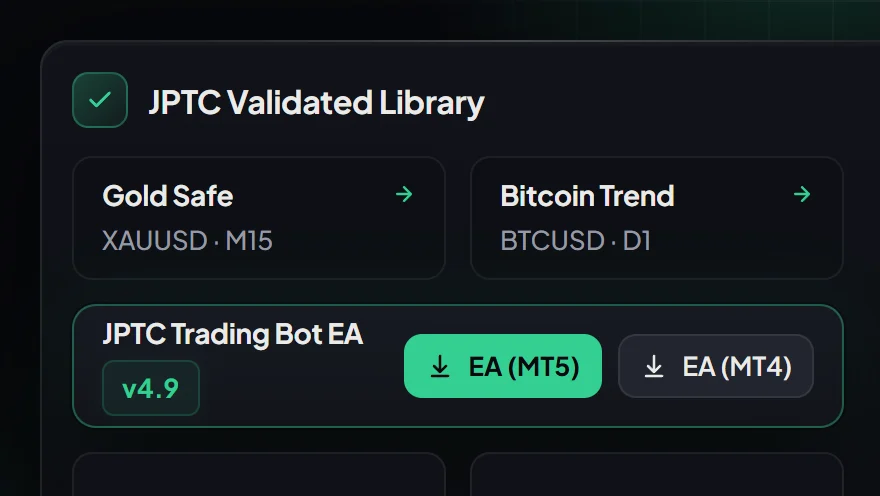
At JPTradingCapital, our JPTC EA Hub provides MT4 and MT5 software that you purchase once, download, and execute directly on your own terminal. You can run it on a reliable PC or VPS where your account provider permits it. The EA Hub is built specifically around prop-firm risk rules, featuring configurable setfiles that allow you to define exact risk per trade, maximum daily drawdown thresholds, and session parameters. Note that a backtest or setfile is not proof of compliance with current prop-firm rules, and no one can promise a challenge pass or payout, but native terminal execution removes the slippage risks inherent in external trade copiers.
Matching Your Trading Goal to the Right Professional Solution
Deciding how to automate or mirror your trading depends on your specific capital structure, platform requirements, and available time. Here is how professional traders structure their options in 2026:
- Prop-Firm Challenge Preparation: If your primary obstacle is navigating strict daily drawdown limits and consistency targets on evaluations, our prop-firm challenge passing service provides structured preparation until the challenge is passed. The account remains strictly in your own name, while firm-terms risk sits with you. Note that no one can promise a challenge pass, as trading always carries inherent market risk.
- Automating Your Personal Broker Account: If you trade with personal capital and want hands-free execution without managing a terminal or VPS, the JPTC Live Algo is hosted directly by us on our own infrastructure and connects to your own broker account. There is nothing to install and no VPS required. A minimum account balance applies, and results are not guaranteed. The hosted Live Algo is built exclusively for your personal broker account and is never offered for prop-firm challenges, evaluations, or prop-firm funded accounts.
- Structured Forex and Gold Signals: For traders who prefer clear analytical trade setups, our forex and gold signals deliver explicit entry prices, stop losses, and target levels. Our signals offer includes supported automatic copying to your own broker account under agreed risk settings and permissions, or you can execute the calls manually. Eligible VIP access is covered through an account at a partner broker.
We believe in verifiable transparency. JPTradingCapital publishes company monthly figures taken directly from our broker statement at our monthly broker figures at /results. These figures are company-published broker statements rather than an independent audit, giving you an honest look at historical system performance.
Frequently Asked Questions
Can I copy trades from an external personal account to a WSFunded challenge?
Why do trade copiers cause daily drawdown violations?
Does the JPTC EA Hub require a trade copier to operate?
Can I use the JPTC hosted Live Algo on a prop-firm account?
Related Articles
- Mechanical Trading Software: Rules, Setup and Risk · Read more →
- Prop Instant Trading: Costs, Risk Rules, and Trade-Offs · Read more →
- Sinal de Trading: How to Execute Forex and Gold Signals · Read more →
- Algo Trading Hosting: VPS Setup or Managed Execution · Read more →
- Trading Strategy Software for Real Accounts and Prop Firms · Read more →
- Accessing Instant Forex Funding: Your Options · Read more →
- Forex Signals: Choosing for Prop Firm or Own Account · Read more →
- Algo Capital: Your Path to Automated Trading Success · Read more →
- Metatrader Automated Trading: EAs, Setup and Rules · Read more →
Automated forex and gold trading
Runs on your own account at your own broker. We host and set it up, so there is nothing to install, no VPS and no copier fleet to maintain. No profit share, no monthly fee.
See how it works