Forex Trading Broker Directory: How to Filter Real Brokers
How to Use a Forex Trading Broker Directory to Filter Real Brokers
A standard forex trading broker directory lists hundreds of retail and institutional choices, but ranking positions often reflect commercial agreements rather than trading infrastructure quality. To select a dependable broker for a real account in 2026, you must filter directory listings by regulatory jurisdiction, true liquidity routing, server latency, and policy regarding algorithmic systems.
Before committing capital to any broker on a directory list, verify these foundational requirements:
- Tier-one or tier-two regulatory oversight that mandates segregated customer funds and regular capital adequacy audits.
- Direct market access or true ECN execution with fixed, transparent commission schedules.
- Low-latency data center connections to major trade matching hubs in London or New York.
- Full platform support for automated systems and trade copying without arbitrary throttling.
Five Critical Broker Metrics That Directories Commonly Overlook
Most directory comparison tables display static minimum spreads and headline leverage figures. In practice, static marketing figures reveal very little about day-to-day execution when trading volatile assets like XAUUSD or major currency pairs. Experienced traders look for specific mechanical constraints before depositing funds into a real account.
1. Fill Latency and Matching Engine Location
Trade execution quality depends heavily on physical distance. Leading institutional brokerages maintain their core trade matching servers in primary data centers such as Equinix LD4 in London or NY4 in New York. When operating automated tools through MetaTrader 4 or MetaTrader 5, a 20-millisecond execution delay during session overlaps can double the slippage you experience on market orders.
2. Raw Spreads Versus All-Inclusive Markups
Directories often highlight zero-commission accounts, but market makers frequently widen the bid-ask spread to incorporate their profit margin, as documented in market liquidity models on Investopedia. For automated strategies and high-volume intraday traders, a raw ECN account charging a fixed round-turn commission with near-zero spreads consistently yields lower overall transaction costs over a long series of trades.
3. Execution Slippage and Order Routing
Directory listings rarely document asymmetric slippage. When an execution bridge passes negative price moves directly to the trader but absorbs positive price improvements, net system expectancy declines over hundreds of executions. A reliable broker operates symmetric order routing where positive fills match interbank liquidity movements.
4. Policies on Automated Execution and Order Frequency
Certain retail brokerages quietly restrict how quickly orders can be opened and closed, or ban automated microsecond order adjustments. If you operate client-side software such as our EA Hub, which the trader runs on their own desktop terminal or an optional VPS, you must ensure the broker supports automated order modifications without artificial throttling or execution delays.
5. Bridge Latency for Copy Trading and External Signals
When routing external trade signals, the latency between the provider server and your broker matching engine dictates whether you receive target entry prices. Liquidity depth matters directly during rollover and high-impact economic releases when thin order books can widen spreads unexpectedly.
Matching Broker Infrastructure to Your Execution Model
A directory ranking cannot identify the right broker for you without considering how your trades are executed. Platform requirements diverge significantly between locally hosted software, hosted automation, and manual or copied signals.
Self-Run MT4 and MT5 Software
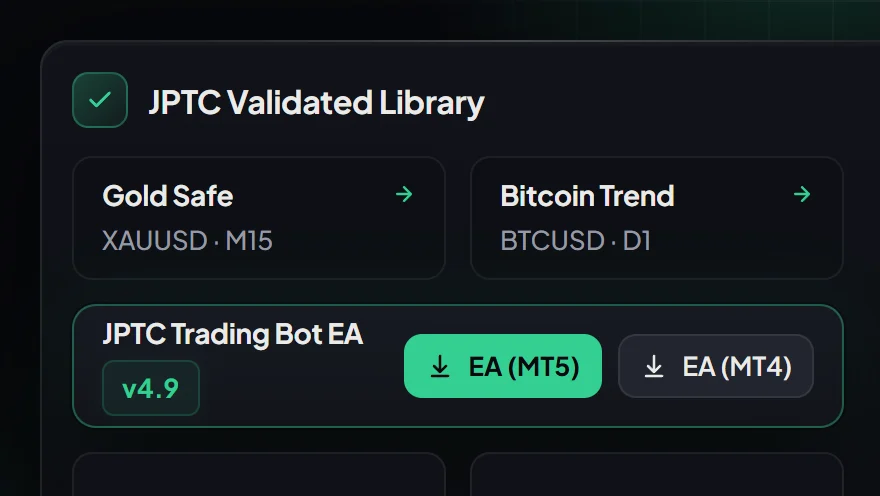
Traders running automated software on their own terminal require raw spread accounts and direct market bridges. The JPTC EA Hub is purchased once and installed directly by the customer on their personal MT4 or MT5 terminal, running on a reliable PC or an optional VPS where permitted. The trading environment demands consistent data feeds without connection dropouts during volatile market sessions.
Hosted Automation on Your Own Broker Account
Traders who prefer hands-off execution without maintaining local hardware look for hosted algorithmic systems. The JPTC Live Algo connects directly to the customer own broker account while running entirely on JPTC infrastructure, meaning there is nothing to install and no VPS required. This hosted algo is built specifically to trade the customer own broker account and is not offered for prop-firm challenges, evaluations, or funded accounts. Company-published monthly figures from our broker statement are available on our /results page; these figures are not independently audited or verified, and trading results are not guaranteed.
Forex and Gold Signals with Supported Copying
For traders following analytical calls, precision trade alerts provide defined entry, stop loss, and target levels. Our signals service includes supported automatic copying to the customer own broker account under agreed risk settings and permissions, while calls can also be followed manually.
How Partner Broker Access Eliminates Overhead Costs
Selecting a broker independently from a directory often means paying retail subscription rates across third-party signal services and analytical tools. Many institutional trading desks and signal networks partner directly with regulated brokers, allowing retail traders to access premium analytical services without separate subscription fees.
Eligible VIP signals access is covered through a partner broker. Opening a funded account through an authorized partner broker enables traders to receive regular forex and gold calls, supported trade copying under agreed parameters, and direct technical setup assistance without recurring VIP membership fees.
If you are evaluating broker options and want direct access to validated market entries on gold and major currency pairs, Get the free VIP signals through our verified partner broker setup.
A Practical Verification Checklist Before Depositing Capital
- Validate the Regulatory Register Entry: Search the national regulatory database directly (such as the FCA, ASIC, or equivalent authority) rather than trusting regulatory badges displayed on a broker website.
- Verify Account Segregation: Confirm that client deposits are held in tier-one custodial banking institutions completely separate from operational company capital.
- Test Terminal Ping: Connect to a demo or micro account inside your MetaTrader terminal and inspect the server network connection tab to view your true millisecond round-trip time.
- Test Small Deposit and Withdrawal Cycles: Execute a small deposit and request a withdrawal early to verify administrative processing times and payment rails before deploying significant trading capital.
- Review Overnight Rollover Tables: Examine financing charges across major pairs and precious metals if your trading strategy holds swing positions across daily market closes.
What is the difference between an ECN broker and a market maker?
An ECN (Electronic Communication Network) broker routes customer orders directly to external liquidity providers, matching buyers and sellers without taking market risk against the client. A market maker operates an internal dealing desk, setting their own bid-ask quotes and acting as the direct counterparty to client trades.
Does a broker directory verify financial solvency?
Most online broker directories operate primarily as affiliate comparison platforms. They summarize visible features and account options, but rarely audit financial balance sheets. Traders should always verify regulatory status and client fund segregation schemes directly with statutory regulators.
Can I run Expert Advisors on any broker listed in a directory?
Not all brokers allow unrestricted algorithmic trading. While many provide MetaTrader terminals, some restrict high-frequency modifications, scalping duration, or hedging. Always confirm that automated trading and algorithmic execution are explicitly permitted under your selected account terms.
How does server latency affect trade copy accuracy?
Latency represents the round-trip delay between a signal being triggered and the corresponding order filling on your broker account. Excessive latency can lead to slippage, causing orders to fill at prices different from the target level. Choosing a broker with low server ping helps preserve execution accuracy.
Related Articles
- Metatrader Automated Trading: EAs, Setup and Rules · Read more →
- Copia de Trades Wsfunded: Rules and Safe Setup · Read more →
- Mechanical Trading Software: Rules, Setup and Risk · Read more →
- Prop Instant Trading: Costs, Risk Rules, and Trade-Offs · Read more →
- Sinal de Trading: How to Execute Forex and Gold Signals · Read more →
- Algo Trading Hosting: VPS Setup or Managed Execution · Read more →
- Trading Strategy Software for Real Accounts and Prop Firms · Read more →
- Accessing Instant Forex Funding: Your Options · Read more →
Automated forex and gold trading
Runs on your own account at your own broker. We host and set it up, so there is nothing to install and no VPS. No profit share, no monthly fee.
See how it works